Materials explained
Why Wooden Furniture Moves with Humidity: A Practical Home Guide
Understand seasonal gaps, sticking drawers and the difference between moisture in room air and water left on a tabletop.
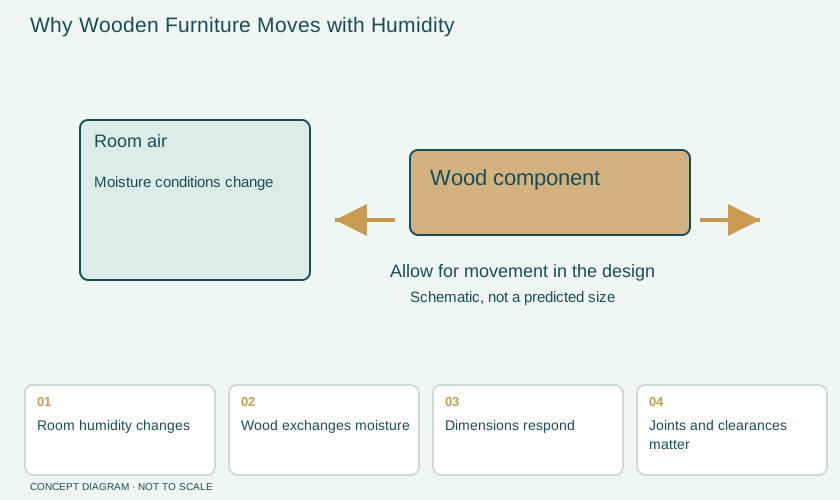
Wood exchanges moisture with its surroundings, so a wooden table or cabinet can change dimensions as indoor conditions change. Give the furniture a stable location, follow its maker’s care instructions and distinguish gradual seasonal movement from leaks, damaged joints or a finish problem.
Furniture knowledge · illustrated explanations and practical room-planning examples, with primary references and product-specific instructions.
Begin with the room, not the polish
A dining table may look exactly the same in every photograph while behaving differently through the year. A drawer becomes harder to close, a small gap appears beside a panel, or an extension leaf fits differently after the heating season begins. These observations deserve attention, but the useful first question is what changed around the furniture. The room may have moved from open windows to continuous air conditioning, or the table may now stand beside a heater. Record that context before applying a treatment or adjusting a fitting.
The USDA Forest Products Laboratory describes wood as hygroscopic: it exchanges moisture with the surrounding environment. Relative humidity, temperature and the wood’s existing moisture condition affect that exchange. The practical implication is that a finished wooden object still belongs to its environment. A finish is part of protection and appearance; it is not a reason to treat the piece as completely isolated from changes in room conditions.
Three kinds of moisture to keep separate
Room humidity, a short spill and a persistent leak require different responses. A room sensor describes the air around it. It does not directly measure the water inside a tabletop. A damp ring from a plant pot is local exposure. A wet wall behind a cabinet can indicate an ongoing building problem. Calling all three situations ‘humidity damage’ makes the response less precise.
| Observation | What to record | Useful first action |
|---|---|---|
| A drawer changes gradually between seasons | Dates, indoor conditions and whether other drawers changed | Check the maker’s guidance before altering the drawer |
| A mark appears under a drink or plant | What touched the surface and how long it remained | Remove the source and follow the finish-specific care method |
| A cabinet back stays damp | Wall condition, plumbing nearby and repeated wet areas | Resolve the source of moisture before restoring furniture |
| A joint opens or a part becomes unstable | Location, photographs and movement under normal use | Stop loading that part and ask for assessment |
Why construction matters as much as the timber name
Two tables described as oak can have different tops, supporting frames and attachment details. One may use solid boards; another may use a wood veneer over a panel. Their behavior cannot be judged from the visible grain alone. Ask for the construction of the top, the edge and the base, then obtain instructions for the finished piece. The material description should explain the object you own rather than merely name a species.
A moving part also needs room to operate. If a door begins rubbing, observe where contact happens. Is it at one corner, along the whole edge or against another object? A hinge adjustment may address an alignment problem, while removing material could create an excessive gap later. Photographing the contact point gives a repairer more useful information than reporting that the cabinet has ‘expanded.’
Make a simple seasonal record
Choose a few repeatable observations: whether the drawer closes without force, whether the table sits steadily and whether a visible gap has changed. Photograph from the same position. Add the date, the room’s usual heating or cooling pattern and any recent relocation. A sensor reading can supplement this record, provided it is taken near the furniture and interpreted as an air measurement. Avoid comparing a reading beside a window with one taken in a distant hallway.
Do not chase every hourly fluctuation with equipment. First ask whether the furniture is exposed to an unusual local condition. A radiator, strong sunlight, a bathroom doorway or a frequently wet floor can explain a concentrated problem. The appropriate indoor range and any acclimation procedure should come from the product maker for the particular construction and destination. A universal number copied from an unrelated product is a poor substitute.
A household example: the relocated sideboard
Imagine a sideboard moved from a sheltered living room to a sunroom. Its owner notices one door rubbing after the move. A useful investigation begins with four photographs: the entire installation, the contact point, the hinges and the area behind the cabinet. The owner notes when the move happened and whether the floor is level. They compare the condition of both doors rather than forcing the affected one shut.
That record allows several explanations to be considered: the furniture may be sitting differently, a hinge may need attention, or the new room may expose it to a different environment. It does not prove which explanation is correct. The next step is a documented conversation with the maker or a competent repairer. Sanding the door immediately would remove evidence and could make a reversible problem harder to correct.
Cleaning robots and wooden furniture
A robot cleaner adds another local exposure to consider. Review where its mop passes, whether water remains near legs and whether the furniture’s feet or lower edges have a suitable cleaning routine. Robot settings cannot replace the furniture maker’s care instructions. If a route repeatedly leaves moisture around a cabinet, change the cleaning arrangement and inspect the area manually. Do not assume the lowest part of an object has the same finish as its tabletop.
A practical checklist
- Identify solid wood, veneer and panel components separately.
- Keep the product’s finish and care information with the receipt.
- Record room changes before adjusting moving parts.
- Remove persistent local moisture sources promptly.
- Photograph a developing gap or rubbing point consistently.
- Ask for advice before sanding, drilling or adding an unapproved coating.
Questions readers ask
Does movement automatically mean poor quality?
No. The existence of seasonal change alone does not establish a manufacturing defect. Its extent, construction, installation and effect on normal use need to be assessed together. A loose joint or unstable component still needs attention even if seasonal movement also occurs.
Can furniture polish fix a sticking drawer?
Polish is not a diagnosis. A drawer can rub because of alignment, installation or changes in surrounding conditions. Use only products approved for that finish and investigate the cause before applying anything to sliding or finished surfaces.
Should I measure moisture inside the wood myself?
A household air sensor and a wood moisture meter answer different questions. Interpreting a wood measurement depends on the instrument, material and method. For a warranty or repair decision, ask the maker or assessor what measurement is useful and how it should be obtained.
Connect the knowledge to your room
Browse the furniture knowledge library, compare whole-home supplier models, or turn your room requirements into comparable furniture quotations. Use the selected product’s own instructions for its assembly, care and operation.
SOURCE NOTES
What the public evidence supports
Primary references checked on October 29, 2026 support the material and product principles discussed here. Household scenarios and diagrams explain the decisions; model-specific instructions govern the selected item.
- USDA Forest Products Laboratory — Wood moisture relationsPrimary reference for the relevant material, product instruction or household-safety point. The worked room examples are editorial illustrations, not tested installations.
- USDA Forest Products Laboratory — Drying and dimensional controlPrimary reference for the relevant material, product instruction or household-safety point. The worked room examples are editorial illustrations, not tested installations.