Comfort and fit
Sofa Foam Explained: Density, Firmness and Support Are Different Questions
Read cushion descriptions without confusing a firm showroom feel with foam density, whole-seat support or a durability guarantee.
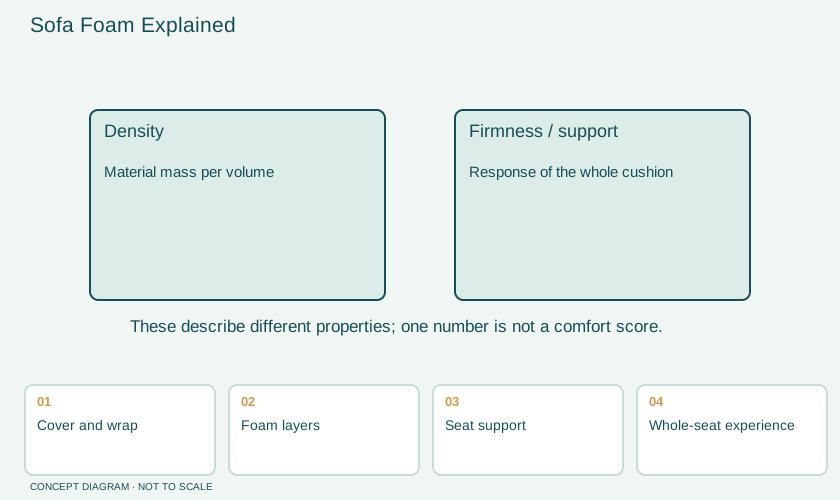
Compare foam density, firmness and the complete cushion construction separately. Density describes mass per volume; firmness describes a measured response to indentation. Your sitting experience also depends on cushion thickness, upholstery, seat geometry and the supporting structure, so a single foam number cannot predict the whole sofa.
Furniture knowledge · illustrated explanations and practical room-planning examples, with primary references and product-specific instructions.
Ask what a cushion description actually measures
A sofa can feel firm in a showroom and still leave unanswered questions about its construction. Another can feel soft at the surface while providing a different response deeper into the cushion. Describing the first as ‘high density’ and the second as ‘low density’ from a quick sit is not a reliable way to compare them. You are feeling the assembled seat, not conducting a controlled measurement of the foam.
The Polyurethane Foam Association distinguishes density from firmness. Density is mass per unit volume. Firmness is evaluated through a defined indentation measurement, commonly described as indentation force deflection. Foam can be formulated so that a higher-density sample is softer than another lower-density sample. Treat the two properties as separate entries in the specification.
Read the seat as a system
The foam core is only part of what you sit on. Upholstery tension, a fiber wrap, multiple foam layers, cushion shape and the structure underneath can change the experience. Seat depth and back angle also influence how you position yourself. A small loose foam sample cannot reproduce all those details. Ask to see a diagram or written description of the complete seat assembly.
| Description | What it helps describe | What it does not establish alone |
|---|---|---|
| Foam density | Mass per volume of a defined foam material | Your preferred softness or the sofa’s lifespan |
| Firmness or IFD result | A sample’s response under a stated indentation method | Complete-seat comfort for every person |
| Cushion thickness | The geometry of one component | Adequate support without the rest of the construction |
| Layered construction | How different materials are arranged | A better result unless the actual arrangement is suitable |
| Fatigue-test result | Change under a stated repeated-loading test | A precise number of years in every home |
When comparing test results, ask whether the methods, sample dimensions and reporting conditions are comparable. A value without its unit or method is incomplete information. Avoid converting a laboratory cycle count into household years unless the manufacturer provides a justified interpretation for that specific product.
A useful showroom routine
Sit as you normally use the furniture. If you usually read upright, test that position rather than judging only a relaxed pose. Check whether your feet and back feel suitably supported for you, and whether you can stand comfortably. Repeat the exercise with a household member who uses the room differently. The goal is to notice practical differences, not declare one firmness universally correct.
Try the actual seat position you plan to use. A center position, corner unit and chaise can have different dimensions and underlying support. Ask whether the displayed upholstery and cushion specification match the configuration on the quotation. If you change the covering or add a different cushion option, ask whether that changes the sitting experience.
Record observations in ordinary language: difficult to stand, too deep for upright reading, comfortable when reclining, or an edge that feels different from the center. These notes are often more useful to a supplier than a vague request for ‘medium premium comfort.’ Keep personal preference separate from a suspected defect or an unsupported durability claim.
An example: two cushions with the same marketing label
Suppose two sofas are both described as using high-density foam. Sofa A provides an exact foam description and a layered cross-section. Sofa B provides only the phrase. The next step is to ask B for equivalent information, not to assume the two cushions are identical. Compare the documented material, thickness, seat support and the complete configuration before comparing price.
Now suppose one family member prefers A’s initial softness while another prefers B’s resistance. That is a preference question. The family can ask about alternative cushion options or choose furniture that supports different uses in the room. Neither reaction alone proves which foam will retain its properties better. Durability evidence needs to be read separately from the sitting notes.
Maintenance and replaceability matter
Ask which cushions can be rotated, reversed or removed and follow the specific instructions. Not every sofa is designed for all three. Find out whether the cushion insert can be replaced without replacing the whole sofa, and whether the covering is removable for its approved maintenance method. A visible zipper is not permission to wash the cover or alter the filling.
Keep the order specification after delivery. If a seat changes noticeably, document the affected position, normal use and any maintenance already performed. Compare similar positions without assuming that every part was built identically. Contact the seller with that record before buying replacement foam based only on a photograph or a generic online density chart.
Useful questions for the supplier
- What materials and layers make up the cushion?
- Which foam values are documented, with units and test methods?
- Does the quotation match the displayed configuration?
- What supports the cushion underneath?
- Which care and rotation instructions apply?
- Can replacement inserts or complete cushions be supplied?
- What evidence and process apply if a seat develops a problem?
Questions readers ask
Does denser foam always feel harder?
No. Density and firmness describe different properties. Compare the documented specifications and sit on the complete sofa rather than inferring one from the other.
Can a thicker cushion solve an uncomfortable sofa?
Thickness is only one part of the assembly. Changing it can also change seat height, back support and fit within the cover. Ask the maker about an approved option before modifying the seat.
Is there one foam grade that is right for everyone?
A household seat needs to suit its construction and users. Use clear technical information to compare products, then evaluate the complete furniture for your own sitting and standing routines. Avoid treating an isolated material label as a universal comfort prescription.
Connect the knowledge to your room
Browse the furniture knowledge library, compare whole-home supplier models, or turn your room requirements into comparable furniture quotations. Use the selected product’s own instructions for its assembly, care and operation.
SOURCE NOTES
What the public evidence supports
Primary references checked on October 29, 2026 support the material and product principles discussed here. Household scenarios and diagrams explain the decisions; model-specific instructions govern the selected item.
- Polyurethane Foam Association — Foam performancePrimary reference for the relevant material, product instruction or household-safety point. The worked room examples are editorial illustrations, not tested installations.
- Polyurethane Foam Association — Foam test methodsPrimary reference for the relevant material, product instruction or household-safety point. The worked room examples are editorial illustrations, not tested installations.
- Polyurethane Foam Association — Furniture case studyPrimary reference for the relevant material, product instruction or household-safety point. The worked room examples are editorial illustrations, not tested installations.