Materials explained
Stone and Porcelain Surfaces: Choose a Care Routine Before a Tabletop
Distinguish material names, stain and etch marks, edges and support before choosing stone-look furniture or interior surfaces.
Identify the actual surface material and finish before choosing cleaners or judging a mark. Natural stone, porcelain and engineered surfaces are different categories, and a stone-look photograph does not identify any of them. Obtain the maker’s care, support and handling instructions for the finished product.
Furniture knowledge · illustrated explanations and practical room-planning examples, with primary references and product-specific instructions.
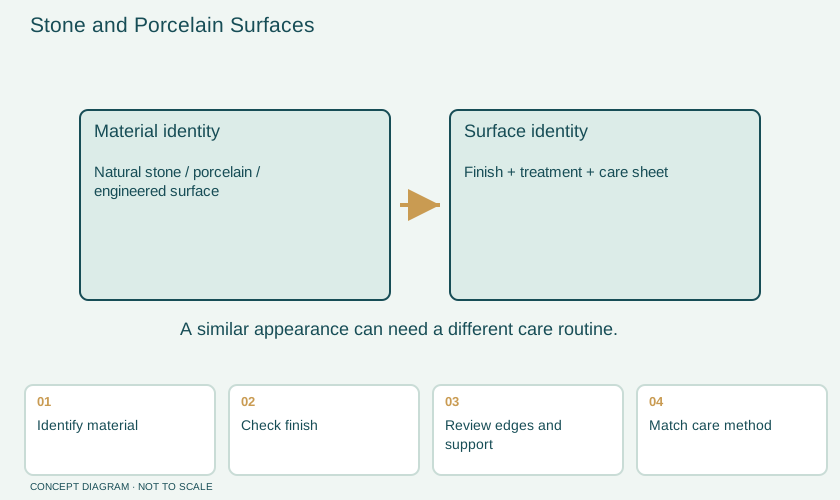
A marble pattern is not a material description
A dining table can show a marble-like pattern while using natural stone, a manufactured surface or a printed finish over another construction. The appearance may be desirable in any of those forms, but the care and handling questions differ. Ask for the actual material, finish and construction of the top. Keep that description with the product record rather than relying on a showroom photograph.
Natural stone also includes several different materials. The Natural Stone Institute explains that composition matters for cleaning: some stones contain minerals that are sensitive to acidic substances. It recommends identifying the stone rather than assuming every stone surface behaves alike. Its guidance is for natural stone; it should not be automatically extended to every porcelain or engineered product with a similar appearance.
Understand the whole tabletop
A surface is part of an assembly. Ask about the top, any backing or supporting layer, the edge construction and how the top is connected to the base. Obtain the finished item’s handling instructions. Do not assume that a slab’s material name tells you how many people should move the table or where it can safely be lifted. Those instructions belong to the product maker.
| Detail | What to request | Why it is useful |
|---|---|---|
| Material identity | Exact surface category and product reference | Establishes the relevant care instructions |
| Finish | Polished, honed, textured or another stated finish | Helps interpret appearance and cleaning guidance |
| Edge construction | Drawing or clear description | Explains the visible thickness and vulnerable details |
| Base and support | Complete assembly information | Keeps handling and use tied to the finished item |
| Cleaning | Approved routine and spill procedure | Avoids transferring a method from a different surface |
| Repair | Who assesses chips, marks and damaged joints | Creates a clear response if a problem occurs |
Keep staining, etching and physical damage separate
A visible mark can have different causes. A spill may leave discoloration, a chemical reaction may change the surface appearance, or an impact may damage an edge. Describing all three as stains can lead to the wrong treatment. Record what happened, photograph the area under normal lighting and check the surface-specific guidance before applying a product.
For natural stone, the Natural Stone Institute distinguishes stain care from acidic damage and explains that an impregnating treatment does not make a surface completely stain-proof. The practical lesson is to ask what a treatment actually protects against. A sealer, coating or stain-resistance claim is not permission to ignore spills or use an arbitrary cleaner.
Make cleaning instructions easy to use
A kitchen or dining area often contains several surfaces close together: a stone top, a coated metal base, an upholstered chair and a wooden cabinet. A household may be tempted to clean them all with one spray. Build a short surface map instead. Label the actual materials and keep approved methods next to the product records. The aim is a routine that can be followed consistently by everyone who cleans the room.
For a new table, ask how to remove ordinary dust and how to respond to a fresh spill. Ask which products or tools should be avoided and whether specialist care is needed for a persistent mark. Do not mix cleaning chemicals or begin an improvised abrasive repair. If the material remains uncertain, resolve that uncertainty before experimenting.
An example: choosing a dining table for a busy household
Imagine a family comparing a natural-stone table with a porcelain-topped table. Rather than asking which broad category is indestructible, they request documentation for both finished products. They compare dimensions, edge details, base arrangement and care instructions. They also examine samples under the lighting used in the dining room, because a small glossy sample can look different from a large tabletop.
The family plans how meals are served and cleared. They want space for placemats, serving dishes and a laptop used between meals. They ask about the recommended protection for hot objects and the handling of common spills for each exact surface. These questions produce a useful care routine without requiring a universal durability ranking.
They also check the route into the home. The tabletop may be delivered separately from the base, or the assembly may require particular handling. Package information and the maker’s instructions determine the plan. A material selected for its appearance should not arrive before anyone has checked how it will enter the room or be assembled.
Floors and robot cleaners need product-specific guidance
A stone or porcelain floor adds grout, joints and installation details to the material decision. Check care instructions for the whole installation, not just a loose tile. Compare the cleaning robot’s permitted products and operating modes with the floor guidance. A device being suitable for one hard floor does not establish compatibility with every finish, joint or treatment.
Inspect wheels, brushes and attachments as part of routine maintenance. Trapped grit or a damaged component can change how cleaning equipment contacts a surface. Keep a manual method for places the device cannot reach. If a mark develops along a repeated route, document both the floor condition and the cleaning arrangement before attributing the cause.
Before ordering or treating a surface
- Obtain the actual material and finish reference.
- Review the complete edge and supporting construction.
- Keep approved routine and spill instructions available.
- Ask what any protective treatment does and does not claim.
- Check package, delivery and assembly arrangements.
- Compare cleaner and equipment guidance for the actual installation.
- Record marks before a specialist treatment or repair.
Questions readers ask
Is every marble-look surface natural marble?
No. Appearance alone does not identify the material. Request the product specification and relevant care instructions.
Does sealing make natural stone stain-proof?
The Natural Stone Institute describes impregnating treatments as improving resistance rather than making a surface completely stain-proof. Follow the instructions for the actual stone and treatment.
Can I use a natural-stone cleaner on porcelain?
Check the porcelain manufacturer’s guidance and the cleaner’s stated application. A method appropriate for one category is not automatically the correct routine for another.
Connect the knowledge to your room
Browse the furniture knowledge library, compare whole-home supplier models, or turn your room requirements into comparable furniture quotations. Use the selected product’s own instructions for its assembly, care and operation.
SOURCE NOTES
What the public evidence supports
Primary references checked on October 29, 2026 support the material and product principles discussed here. Household scenarios and diagrams explain the decisions; model-specific instructions govern the selected item.
- Natural Stone Institute — Care and cleaning of natural stonePrimary reference for the relevant material, product instruction or household-safety point. The worked room examples are editorial illustrations, not tested installations.
- Tile Council of North America — Porcelain vs. non-porcelainPrimary reference for the relevant material, product instruction or household-safety point. The worked room examples are editorial illustrations, not tested installations.