Room systems
Window Types and Performance Labels: Plan Around the Whole Opening
Separate opening style from energy ratings, then check furniture, shades, controls and maintenance access around the actual window.
Choose a window opening style for the room’s access and operating needs, then evaluate the exact product’s performance ratings and installation requirements. A frame material or opening style alone does not establish energy performance, noise reduction or suitability for a particular climate.
Furniture knowledge · illustrated explanations and practical room-planning examples, with primary references and product-specific instructions.
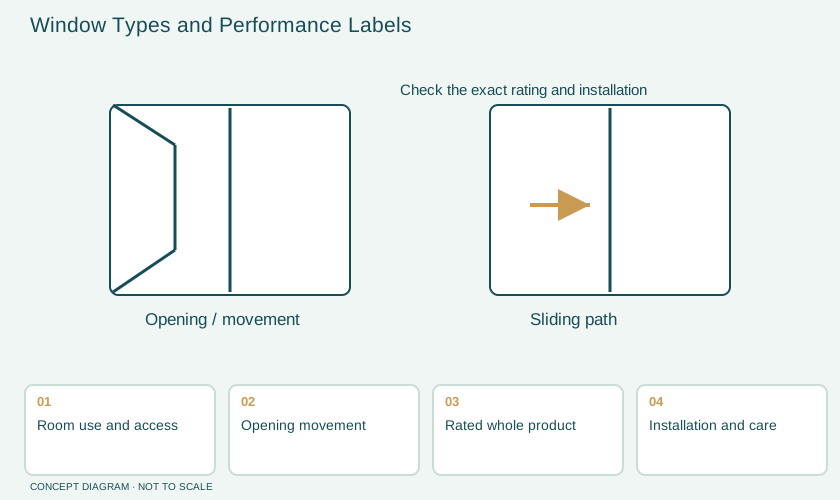
An opening belongs to a furnished room
A window decision affects more than the wall elevation. Consider the desk below it, the curtain beside it, the person operating the handle and the space needed for the sash to move. A window that looks suitable in a catalog may be inconvenient behind a deep sofa or beside a cabinet. Begin with a room plan that includes normal furniture positions and access to the opening.
Keep three questions separate. How does the window open? What performance is documented for the exact product? How will it be installed and maintained in this building? A statement about one question does not answer the other two. For example, a preferred opening style does not establish a particular thermal rating or remove the need for an appropriate installation detail.
Describe the opening movement clearly
A sliding window moves along a track; a hinged sash swings around its hinges; vertically moving sashes use another arrangement. Fixed glazing does not provide an operating sash. Each description helps you think about reach, furniture interference, screens and cleaning. Ask the supplier to show the exact operation instead of relying on an unfamiliar name that may vary between markets.
| Room question | What to show on the plan | What to confirm with the supplier |
|---|---|---|
| Can a person reach the handle? | Furniture depth and normal standing position | Actual handle location and operation |
| Does an opening part conflict with furniture? | Sash movement and nearby objects | The complete movement envelope |
| How are curtains or blinds arranged? | Recess, brackets and fabric position | Compatibility with opening and maintenance access |
| How is cleaning performed? | Interior and exterior access | Product instructions and suitable service arrangements |
| What performance is required? | Location, exposure and building brief | Ratings and documentation for the exact unit |
Avoid assuming every product of a named style operates identically. Hardware and size can change the practical experience. If a demonstration is possible, operate the actual proposed arrangement and ask what routine maintenance it needs. For a difficult location, plan access before approving the window and surrounding furniture.
Read energy labels as product information
ENERGY STAR explains that qualifying windows use independently certified NFRC ratings and that criteria vary with climate. The useful lesson is to evaluate the documented whole product in context. Do not infer certification from a frame color, a generic glass description or the fact that a manufacturer sells another certified model. Ask for the label and model identification for the proposed unit.
The NFRC consumer guide explains distinct ratings. U-factor describes heat transfer through the product; solar heat gain coefficient describes admitted solar heat; visible transmittance describes admitted visible light. These are different questions. Selecting the lowest or highest value indiscriminately is not a design method. Climate, orientation and the room’s needs determine the relevant comparison.
A performance label also has a defined scope. Energy ratings are not a universal certificate for acoustic performance, security or every installation condition. If those properties matter, identify the evidence required for that property and exact product. Keep claims attached to the relevant report instead of collecting several unrelated marketing statements.
Frame material is one part of the assembly
Wood, aluminum, vinyl, fiberglass and composite constructions can appear in window products. Their category names do not replace a complete description of frame design, glazing, seals and hardware. Compare the documentation for the assembled unit. Ask how exposed finishes are maintained and whether replacement parts or adjustment services are available for the destination.
This is particularly important when furniture and windows are ordered through different parties. Give both parties the same room drawing. A cabinet supplier needs to know the opening movement and handle access; the window installer needs to know which surfaces and finished elements will be nearby. Clear coordination prevents a drawing from showing two components occupying the same usable space.
An example: a home-office desk beneath a window
Imagine a household placing a deep desk beneath an opening window. The room looks attractive in a rendering, but the owner cannot comfortably reach the handle once a display and lamp are installed. They revise the plan before ordering: measure the furniture position, identify the operating handle and test whether the normal opening action is accessible. They also check curtains and the position of cables.
Separately, they ask the window supplier for the exact model’s ratings and a recommendation suited to the building brief. They do not assume that changing the opening style alone will solve summer glare or winter discomfort. A suitable shading arrangement, product specification and installation detail need their own evaluation.
The final record contains a window schedule, furniture plan, operating instructions and care information. These documents make future cleaning, adjustment and replacement more straightforward. They also preserve which product was actually selected, rather than a broad catalog family that may contain several different configurations.
Installation and maintenance need a plan
Ask the appropriate installer or designer to address the building interface and applicable local requirements. This article explains decision categories rather than prescribing structural, ventilation or escape dimensions. Do not replace that assessment with a generic internet dimension. Record who is responsible for measurement, installation, finishing and post-installation adjustment.
After installation, check operation using the product’s instructions. Confirm that nearby furniture, blinds and decorative objects do not obstruct ordinary use. Keep model labels and the documentation that came with the opening. If operation changes later, record the location and symptoms before making unapproved hardware changes.
Questions readers ask
Is one opening style always more energy-efficient?
Compare ratings for the exact whole products. Opening style alone is not sufficient evidence for a universal performance ranking.
Does an ENERGY STAR statement apply everywhere?
The program has its own product and climate criteria. Check the exact certification, product identification and destination requirements rather than treating the name as a worldwide installation approval.
Should furniture be planned after the windows arrive?
Plan them together. A shared drawing helps identify operating access, furniture interference, curtains and maintenance needs while changes are still straightforward.
Connect the knowledge to your room
Browse the furniture knowledge library, compare whole-home supplier models, or turn your room requirements into comparable furniture quotations. Use the selected product’s own instructions for its assembly, care and operation.
SOURCE NOTES
What the public evidence supports
Primary references checked on October 29, 2026 support the material and product principles discussed here. Household scenarios and diagrams explain the decisions; model-specific instructions govern the selected item.
- ENERGY STAR — Windows, doors and skylights criteriaPrimary reference for the relevant material, product instruction or household-safety point. The worked room examples are editorial illustrations, not tested installations.
- NFRC Consumer Guide — Window ratingsPrimary reference for the relevant material, product instruction or household-safety point. The worked room examples are editorial illustrations, not tested installations.
- NFRC Consumer Guide — Types and partsPrimary reference for the relevant material, product instruction or household-safety point. The worked room examples are editorial illustrations, not tested installations.