Materials explained
Solid Wood, Veneer, Plywood and MDF: Read Furniture Materials Clearly
Separate the visible finish, structural core and edge construction before deciding whether a cabinet or table suits your home.
Read furniture as a combination of surface, core, edges and joints. Solid wood, veneer, plywood and MDF describe different parts or constructions; none of these words alone tells you the quality of the complete piece, its care needs or its suitability for a damp room.
Furniture knowledge · illustrated explanations and practical room-planning examples, with primary references and product-specific instructions.
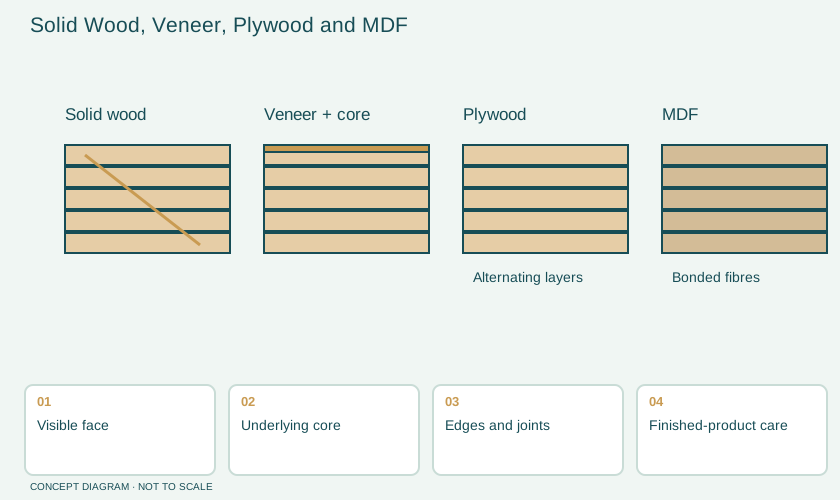
A wood appearance is only the beginning
A photograph can show an attractive grain pattern without explaining how a cabinet was built. The broad face may be a thin real-wood layer, the edge may be a separate solid strip and the supporting panel may have a different composition again. That is not inherently a contradiction. Furniture frequently combines materials so that visible surfaces, shaped parts and large panels perform different jobs. The important point is whether those materials are described accurately.
Start with a drawing of the piece. Label the top, sides, shelves, doors, legs and back. Then ask what each part is made from. This simple exercise produces a much clearer specification than asking whether the whole item is ‘real wood.’ It also helps when comparing a repaired piece, an imported item or an existing cabinet with replacement doors.
Understand the four descriptions
Solid wood refers to wood material rather than a panel made by combining fibers or layers. Veneer is a thin wood layer used on a supporting substrate. Plywood uses bonded wood veneers arranged in layers. Medium-density fiberboard, or MDF, is a wood-based fiber panel. The USDA Wood Handbook distinguishes wood and wood-based composite products and explains why construction has to be considered alongside the material name.
These descriptions do not replace a full specification. A veneered surface still needs its core identified. A plywood component still needs suitable grade, construction and finish information. An MDF door still needs its coating, edges and fixing details explained. ‘Engineered wood’ is a broad category rather than a precise answer to any of those questions.
| Term on a quotation | Next question to ask | Detail that a photograph cannot settle |
|---|---|---|
| Solid wood | Which components and which species? | Whether the broad top and hidden parts use the same construction |
| Wood veneer | What is the supporting panel? | Core, edge treatment and repair limits |
| Plywood | What construction is specified for this component? | Layer quality, fixing details and suitability for the application |
| MDF | What finish and edge protection are supplied? | Treatment of drilled holes, exposed edges and damp locations |
| Wood effect | Is the appearance printed, laminated or a wood veneer? | Surface composition and cleaning requirements |
Separate appearance from the job a part must do
A curved leg, a broad cabinet door and a long shelf do different work. Asking one material label to answer all three design problems obscures that difference. For a shelf, ask about the complete span, expected use, supporting arrangement and the manufacturer’s stated load guidance. For a door, ask about the hinges, adjustment and approved hardware. For a tabletop, ask about the top construction, the base and the care instructions for the finish.
Avoid deriving a load rating from a board name or a thickness seen in an image. The complete assembly matters. A shelf supported at several points is not the same product as an apparently similar shelf with only end supports. Likewise, adding extra hardware after delivery should follow the maker’s instructions rather than an assumption about the core.
Edges deserve their own inspection
Open the door and inspect the lower edge, corners and handle area. Look at where the surface material meets the edge treatment. Ask how the maker expects the piece to be cleaned and what to do if an edge is damaged. These questions are particularly useful in a bathroom, utility room or home where floors are frequently wet-mopped. A neat broad face does not tell you how every less-visible surface has been finished.
For a cabinet beside a robot-mopping route, include its feet and plinth in the discussion. Can the cleaner reach underneath? Is there a protected base or a vulnerable edge close to the floor? This is an installation and maintenance question, not an argument that one broad material category is always unsuitable. Obtain guidance for the actual product and cleaning arrangement.
A practical comparison: two sideboards
Suppose sideboard A is described as oak veneer and sideboard B as solid oak. Instead of ranking them from the labels alone, create a component list. Record each top, door, shelf, back and leg. Request overall dimensions and usable shelf dimensions. Compare door alignment, the intended loading, hardware availability and care requirements. If A has a documented construction and suitable features while B has only a generic description, the better next action is to request missing information from B.
The appearance decision is separate. Examine samples in your own lighting and beside the floor. A consistent grain may be desirable in one room, while visible variation may suit another. Neither preference changes the need for a clear construction description. Keep the approved sample reference with the order so that a future repair or replacement can start from known information.
Care follows the finish
Manufacturers publish care guidance by material and finish because cleaning methods are not interchangeable. Herman Miller’s resources, for example, distinguish wood and veneer, textiles, leather and other finishes. Treat that structure as a useful model for organizing your own household documents: one care record for each actual surface. Do not apply instructions from an unrelated finish simply because both objects look wooden.
Keep abrasive tools, excessive moisture and unapproved cleaners out of an improvised repair attempt. If a mark appears, record what caused it and consult the relevant instructions. A thin decorative surface can have different repair options from a solid component; ask before sanding.
Before you buy or modify a piece
- Obtain a component-level material description.
- Identify the finish on exposed and frequently touched surfaces.
- Check dimensions, intended loading and supporting details.
- Ask about replacement hardware and permitted adjustments.
- Inspect edges, holes and areas close to the floor.
- Save samples, drawings and care information together.
Questions readers ask
Is veneer fake wood?
A wood veneer is a thin layer of wood. It is different from a printed wood-look surface. The useful follow-up question is what lies beneath it and how the full component is constructed.
Is solid wood always the best choice?
A material label alone cannot decide that. Consider the part’s purpose, construction, appearance, maintenance and your room. Ask for evidence about the finished product rather than assuming a universal ranking.
Can I replace hardware without identifying the core?
First obtain the maker’s instructions. Fastener type, hole condition and supporting material affect an alteration. If the original fitting has failed, document it and get repair advice rather than installing a larger screw by guesswork.
Connect the knowledge to your room
Browse the furniture knowledge library, compare whole-home supplier models, or turn your room requirements into comparable furniture quotations. Use the selected product’s own instructions for its assembly, care and operation.
SOURCE NOTES
What the public evidence supports
Primary references checked on October 29, 2026 support the material and product principles discussed here. Household scenarios and diagrams explain the decisions; model-specific instructions govern the selected item.
- USDA Forest Products Laboratory — Wood HandbookPrimary reference for the relevant material, product instruction or household-safety point. The worked room examples are editorial illustrations, not tested installations.
- Herman Miller — Material care and guidesPrimary reference for the relevant material, product instruction or household-safety point. The worked room examples are editorial illustrations, not tested installations.