Materials explained
Fabric and Leather Upholstery: Understand the Surface Before Cleaning
A practical guide to upholstery labels, removable covers, sample checks and a care record that keeps household cleaning consistent.
Choose upholstery by its exact material and finish, then match the cleaning method to the manufacturer’s instructions. A removable cover is not automatically machine-washable, a leather label does not describe every coating, and a stain-resistant claim still needs clear scope and care guidance.
Furniture knowledge · illustrated explanations and practical room-planning examples, with primary references and product-specific instructions.
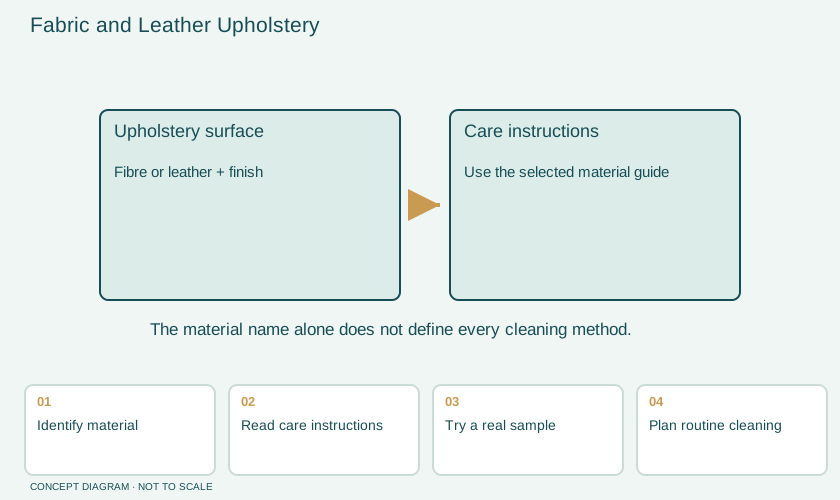
Start with the actual upholstery specification
The word fabric covers a large range of fibers, weaves, textures and finishes. Leather also covers varied surfaces and treatments. A marketing description such as ‘premium upholstery’ tells a household very little about the cleaning routine, the feel under normal lighting or what happens when a cushion cover needs replacing. Ask for the exact material name, color reference and care instructions before deciding.
Keep the surface material separate from the rest of the cushion. A seat can combine a covering, lining, fiber wrap and foam core. When a supplier describes it as leather or woven fabric, that usually does not describe all those hidden components. Ask which surfaces use the specified covering: the seat, the back, the sides and the less-visible rear of the sofa may need separate confirmation.
Compare the questions, not broad promises
| What you are evaluating | Useful question | Household implication |
|---|---|---|
| Fiber or leather specification | What exact material and finish is supplied? | Establishes the correct care reference |
| Color and texture | Can I examine a labeled physical sample? | Helps judge the material beside existing furniture |
| Removable covers | Which parts remove, and how are they cleaned? | Prevents confusing a zipper with washability |
| Performance claim | Which test or stated condition supports the claim? | Keeps the claim attached to an actual material |
| Replacement parts | Can I reorder covers or matching upholstery? | Helps plan repairs without promising a future color match |
Avoid turning a single durability number into a complete ranking. A test can describe one property under stated conditions, while household use includes seams, cushion movement, pets, clothing and cleaning. Ask what a reported result measures and whether it applies to the exact material being supplied. If no report is available, record that as missing information rather than inventing an equivalent result.
Use samples as a decision tool
A sample is useful for texture, color and coordination. Place it in the room where the furniture will stand. Look at it in daylight and under the lamps normally used in the evening. Set it beside the floor, curtains and another upholstered piece. Examine the label and keep its reference number. A photograph of the sample in the room is a helpful record, although camera settings can change apparent color.
Do not use an unapproved household stain experiment on the only sample and assume it represents a laboratory result. Instead, ask the supplier to demonstrate the stated care procedure and explain its limits. If a cleaning product is recommended, request the exact instructions and any requirement for testing in an inconspicuous place. Preserve an untouched sample for comparison after delivery.
A care routine should be specific and easy to follow
Manufacturer guidance often separates leather, textiles and other materials. Herman Miller’s material resource library does this explicitly, with different care documents rather than a single universal cleaning method. The lesson for a household is to organize instructions by the actual product and finish. A cleaner suitable for a dining chair is not automatically suitable for a sofa from a different maker.
Build a short care card containing the product name, upholstery code, permitted routine cleaning, instructions for spills and the supplier’s contact details. Keep it available to everyone who cleans the room. If a cover requires professional cleaning, state that clearly. If a cushion has a zipper for manufacturing or maintenance access, do not infer that the cover can be laundered at home.
An example: a family choosing a living-room sofa
Imagine a family choosing between a textured fabric sofa and a leather sofa. Their main problem is not selecting a supposedly superior category. One person wants a soft texture; another wants a simple cleaning routine; a child regularly eats in the room. They ask both suppliers for exact material codes and care sheets, then compare the routines with how the room is actually used.
The fabric option has removable seat covers, but the care sheet specifies a particular professional method. The leather option has a defined finish and its own permitted routine. This information changes the discussion: cover removal and routine cleaning are different features. The family can now decide whether either routine fits their habits, or whether they need a third option with better-documented maintenance.
They also ask about seams, cushion access and replacement parts. A removable cushion can make routine access easier, but the final arrangement still needs to be comfortable and stable. They sit in the proposed configuration and check how cushions move when someone stands. That observation is useful for choosing the sofa; it is not a claim about years of durability.
Consider cleaning robots around upholstery
A robot cleaner mainly interacts with the floor and lower furniture geometry. Check dangling fabric skirts, loose throws and cables near the sofa rather than assuming the upholstery itself is irrelevant. Follow the device’s instructions for obstacles and the furniture maker’s guidance for the base. Keep cleaning solutions intended for hard floors away from an unapproved upholstery-cleaning routine. A robot reaching underneath does not replace manual inspection of spills or marks on the furniture.
Keep a simple maintenance record
- Save the exact upholstery name and color code.
- Keep routine cleaning instructions with the product record.
- Check whether each removable cover is washable, professionally cleanable or handled another way.
- Record approved products and methods rather than generic cleaner categories.
- Photograph a spill or defect before attempting a major treatment.
- Ask about replacement covers, cushions and upholstery availability.
Questions readers ask
Does performance fabric mean stain-proof?
No single phrase establishes that. Ask what performance is claimed, under what conditions and how the material should be maintained. A documented claim should identify the exact covering rather than every fabric sold by the company.
Is leather always easier to care for?
Compare the actual care sheets. Different finishes can require different treatment, and a preferred feel does not establish a universal maintenance advantage. Choose a surface and routine that suit your household.
Can I wash any cover that has a zipper?
No. Confirm the instructions for that exact cover. A zipper can provide access without making the cover suitable for home laundering, and cleaning the cover may involve more than removing it from the cushion.
Connect the knowledge to your room
Browse the furniture knowledge library, compare whole-home supplier models, or turn your room requirements into comparable furniture quotations. Use the selected product’s own instructions for its assembly, care and operation.
SOURCE NOTES
What the public evidence supports
Primary references checked on October 29, 2026 support the material and product principles discussed here. Household scenarios and diagrams explain the decisions; model-specific instructions govern the selected item.
- Herman Miller — Material care and guidesPrimary reference for the relevant material, product instruction or household-safety point. The worked room examples are editorial illustrations, not tested installations.
- Herman Miller — Leather care and maintenancePrimary reference for the relevant material, product instruction or household-safety point. The worked room examples are editorial illustrations, not tested installations.
- Herman Miller — Textiles care and maintenancePrimary reference for the relevant material, product instruction or household-safety point. The worked room examples are editorial illustrations, not tested installations.