Room systems
Lumens, Watts and Kelvin: Lighting Terms for a More Useful Room
Read bulb labels, separate brightness from color appearance and plan task lighting around the furniture you actually use.
Use lumens to compare a bulb’s light output, watts to understand its power use and color temperature to describe the appearance of the light. Then consider the fixture, shade, placement and task. Matching one label value does not guarantee the same experience in a furnished room.
Furniture knowledge · illustrated explanations and practical room-planning examples, with primary references and product-specific instructions.
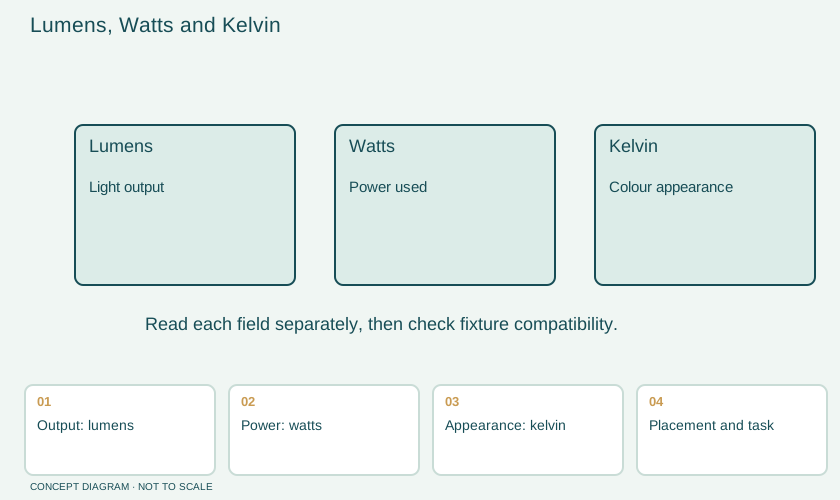
A bright bulb and a useful light are different decisions
A room can contain a bright ceiling light and still feel inconvenient for reading, food preparation or working at a desk. The problem may be placement, a shade that directs light away from the task or a reflection on a screen. Before choosing another bulb, describe what the room needs to do. Identify the chair where someone reads, the surface where keys are sorted and the desk used after dark.
The Federal Trade Commission explains the basic shopping distinction: lumens describe a bulb’s light output, while watts describe power use. The appearance of the light, from warmer to cooler, is a separate label item. Correlated color temperature is commonly expressed in kelvin, shown by the symbol K. Treat these as separate decisions rather than assuming that a higher wattage, a cooler appearance or a familiar bulb shape automatically solves the room’s problem.
Translate the terms into questions
| Term | What it describes | Question for the room |
|---|---|---|
| Lumens | The bulb’s light output | Is this the intended output for the fixture and task? |
| Watts | Power used by the bulb | Is it compatible with the fitting and its stated limits? |
| Color temperature | The apparent warmth or coolness of the light | Does the appearance suit nearby lighting and materials? |
| Dimming compatibility | Whether the product works with the specified controls | Will this bulb, driver or fixture work with the actual dimmer? |
| Beam or light distribution | Where the fixture sends light | Does useful light reach the task without an awkward reflection? |
A bulb label helps compare products, but it does not describe every aspect of the installed result. A dark shade and a translucent shade can direct light differently. An exposed source at eye level can be uncomfortable even if the total output seems suitable. Look at the actual fixture and room arrangement as well as the package.
Plan lighting in layers
A useful way to organize a room is to distinguish general illumination, task lighting and light used to emphasize an area or object. These are planning categories, not a requirement to install three fixtures everywhere. In a small room, one well-placed fitting may serve more than one purpose. The point is to explain the job of each light rather than buy several lamps that duplicate one another.
For the reading chair, consider a light that reaches the page without sitting directly in the reader’s line of sight. For a desk, examine the position of the display and the direction of reflections. For a dining setting, review the pendant together with the actual table position. Moving the table after the wiring is complete can change the relationship the design relied on.
Compare light appearance beside real materials
A sofa fabric, wood finish or painted cabinet may appear different under different lighting. Bring material samples into the room and examine them under the lights you intend to use. Keep the lamp or bulb specifications with the sample record if color coordination is important. This is a household comparison, not a calibrated color measurement, but it can reveal a mismatch before ordering a large item.
Avoid mixing light appearances accidentally. Two lamps bought at different times may create a visible contrast that was not intended. Sometimes a deliberate contrast is useful, such as a different work area. Record the purpose rather than trying to make every light identical by default. Consistency should serve the room’s activities and appearance.
An example: a living room that becomes a workspace
Imagine a living room used for relaxing in the evening and occasional laptop work. The existing ceiling light produces a reflection on the screen, while the reading corner remains inconvenient. Adding more ceiling output might intensify the reflection without solving the reading task. The household instead maps the two activities and tests the placement of portable lamps.
They try a reading lamp beside the chair and a separate light for the desk area, keeping cables away from the route between the sofa and doorway. They compare bulb labels and check fixture instructions before selecting products. If a smart control is desired, they confirm the specific device and control compatibility rather than assuming every LED bulb supports the same arrangement.
At night they test several ordinary activities: reading, watching the screen, walking through the room and finding objects on a side table. They record which light is needed for each. This gives a practical control plan and reveals whether switches are reachable from the normal seating positions. It also prevents the room from depending entirely on a phone for everyday lighting.
Plan cables and cleaning access
A lamp’s location includes its cable path. Review sockets, furniture legs and routes used by a robot cleaner. Follow the electrical product’s instructions and avoid improvised wiring changes. If an outlet or fixed fitting must move, obtain appropriate professional help. A furniture layout should identify the desired location and access needs so that the electrical work can be designed properly.
Keep power supplies and controls accessible for their stated use. Do not conceal them inside furniture without checking installation guidance. A tidy photograph is not evidence that a concealed arrangement is suitable. Plan how a bulb or component will be replaced and how the surface behind the lamp will be cleaned.
A room-lighting checklist
- List activities and the furniture positions where they occur.
- Compare lumens, watts and light appearance separately.
- Check the fixture’s instructions and product compatibility.
- Look for reflections from normal sitting positions.
- Examine material samples under intended lighting.
- Plan controls, replacement access and cable routes.
- Test an ordinary evening routine before finalizing the layout.
Questions readers ask
Does a higher wattage always mean more light?
Watts describe power use. Compare lumens when comparing bulb output, and still check how the fixture distributes that light.
Does a cooler appearance mean a brighter bulb?
Appearance and output are separate label items. Compare each value instead of judging one from the other.
Can a smart bulb replace every dimmable bulb?
Check the exact bulb, fixture and controls. Products have specific compatibility and operating instructions; a general smart-lighting label does not establish the right combination.
Connect the knowledge to your room
Browse the furniture knowledge library, compare whole-home supplier models, or turn your room requirements into comparable furniture quotations. Use the selected product’s own instructions for its assembly, care and operation.
SOURCE NOTES
What the public evidence supports
Primary references checked on October 29, 2026 support the material and product principles discussed here. Household scenarios and diagrams explain the decisions; model-specific instructions govern the selected item.
- US Federal Trade Commission — Shopping for light bulbsPrimary reference for the relevant material, product instruction or household-safety point. The worked room examples are editorial illustrations, not tested installations.
- US Department of Energy — LED basicsPrimary reference for the relevant material, product instruction or household-safety point. The worked room examples are editorial illustrations, not tested installations.