Care & safety
Modular Furniture Explained: Reconfiguration, Repair and Moving Home
Modular, flat-pack and repeatedly demountable describe different things. Learn which questions reveal the useful difference.
Check how modules connect, which configurations the maker permits and whether the product is designed for repeated disassembly. A piece that arrives flat-packed is not automatically suitable for unlimited dismantling and rebuilding.
Furniture knowledge · illustrated explanations and practical room-planning examples, with primary references and product-specific instructions.
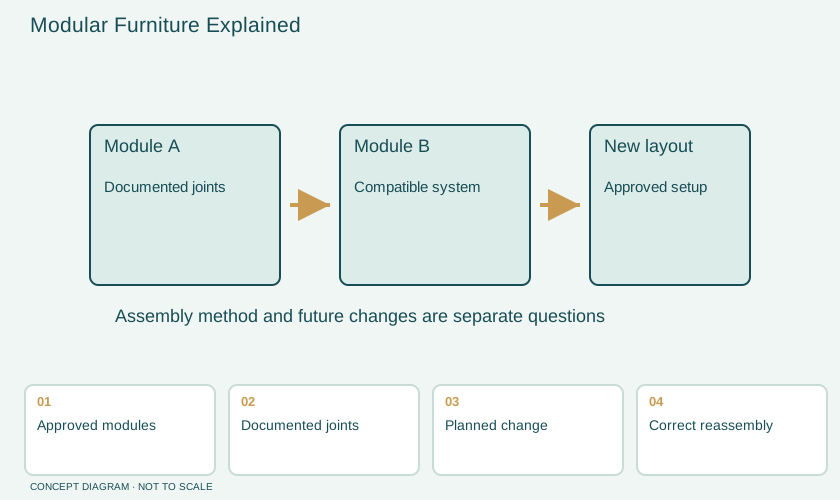
Three labels that do different jobs
Modular describes a system made from components that can be combined in specified ways. Flat-pack describes how an item is supplied. Demountable describes an ability to take parts apart, although the permitted method and number of moves still depend on the product. These labels can overlap, but treating them as synonyms creates expectations that the hardware or panels may not support.
Start with the change you actually expect. A sofa may need one extra seat when a family moves. A storage wall may need a different arrangement when a child starts school. A dining table may simply need to fit through a door. These are different problems and require different connections, dimensions and support arrangements. Choose a system whose documented options match the likely change.
Read the connection, not just the catalogue layout
Ask how two units attach and whether that attachment is required for safe use. Some modules stand separately; others work as a supported assembly. A shelf can look like a simple box while relying on a back panel, wall fixing or neighbouring unit for stability. Follow the installation instructions for the exact configuration rather than borrowing an image from a different model.
Identify replacement hardware before buying. A named connector, hinge or foot is easier to discuss than an unlabelled bag of spare screws. Request the assembly instructions, parts list and approved adjustment procedure. A retailer's ability to supply a replacement today is useful, but it is not a guarantee of indefinite availability. Store the identification with the furniture records so later enquiries refer to the correct version.
| Question | Why it changes the decision | Useful evidence |
|---|---|---|
| Which layouts are permitted? | Appearance alone does not establish stability | Configuration instructions |
| Can the joints be reopened? | Fasteners behave differently | Disassembly guidance |
| Are modules sold separately? | A future extension needs matching parts | Current system catalogue |
| Which panels provide bracing? | Removing one may change support | Assembly drawing |
| What can be replaced? | Repair requires specific components | Parts list and seller response |
Repeated assembly is a product-specific issue
Official IKEA guidance illustrates an important distinction: some products can be dismantled, but many are not designed around repeated disassembly. Connections driven directly into a panel can behave differently from threaded inserts or other removable fittings. That does not make one visible fastener a complete quality verdict. Panel material, assembly method and the whole structure all matter.
Before moving, ask the maker which components should stay assembled and how the item should be supported during handling. Do not assume reversing every step is safe or practical. A large panel, mirror or mechanism may need more than one person or professional help. Keep doors, drawers and moving parts secured according to the instructions, and avoid handling an unsupported frame as though it were a rigid box.
An example: a changing home office
A household begins with a desk, low storage and one tall unit. They expect the room to become a guest room later. They compare two plans: a fitted arrangement sized to the first layout, and a modular set whose individual units can be reused. The second plan offers flexibility only if the units still work in the future positions and can be installed in the permitted configurations.
They save a drawing of both arrangements, including outlets, door movement and wall attachments. They also check whether the desk top can be removed without dismantling every cabinet. The decision is based on the actual transition rather than a general promise that modular furniture is always more sustainable or cheaper. A durable fixed item can also be a sensible choice when the room will remain stable.
Plan for repair as part of the system
A removable cover, replaceable foot or separately available drawer front can make a particular repair more straightforward. Ask which changes the manufacturer supports and which affect a warranty or structural performance. A modular sofa may allow a damaged module to be replaced, but its fabric colour can still vary across batches. Document the original material code and be realistic about later matching.
Keep a small digital record: model, version, assembly instructions, connector photographs, finish codes and supplier contact. Label spare parts accurately and store them away from children. When an item loosens or becomes unstable, stop using it in a way that could cause harm and follow the maker's support guidance. Repeatedly tightening an unsuitable joint without finding the cause is not a repair strategy.
Before the next move
- Find the correct model instructions and any disassembly guidance.
- Photograph installed joints and label components without damaging finishes.
- Identify parts that should remain assembled or need professional handling.
- Pack hardware by item and preserve labels, not just a mixed screw bag.
- Reassemble in an approved configuration and complete all required attachments.
- Review the new room's access, movement and cleaning routes.
Questions about modular systems
Does modular mean custom-made?
No. A system can use standardized modules with many combinations, while a custom product may be built for one fixed location. Ask which dimensions and connections are standardized and which can change.
Is a visible screw a sign of poor quality?
Not by itself. Judge the complete joint, materials, intended loads, instructions and evidence. Concealed hardware also needs suitable design and assembly.
How should flexibility appear in a furniture brief?
Name the expected future arrangement and the parts that must be reusable. A concrete scenario allows suppliers to show relevant options instead of repeating a broad flexibility claim.
Connect the knowledge to your room
Browse the furniture knowledge library, compare whole-home supplier models, or turn your room requirements into comparable furniture quotations. Use the selected product’s own instructions for its assembly, care and operation.
SOURCE NOTES
What the public evidence supports
Primary references checked on October 29, 2026 support the material and product principles discussed here. Household scenarios and diagrams explain the decisions; model-specific instructions govern the selected item.
- IKEA Japan — disassembly and reassembly guidancePrimary reference for the relevant material, product instruction or household-safety point. The worked room examples are editorial illustrations, not tested installations.
- IKEA — finding assembly instructionsPrimary reference for the relevant material, product instruction or household-safety point. The worked room examples are editorial illustrations, not tested installations.