Care & safety
Furniture Tip-Over Prevention: What a Whole-Home Plan Must Include
Treat stability, correct attachment and everyday storage as part of the furnishing plan.
Follow the furniture and TV manufacturers’ attachment instructions, use suitable installation for the actual wall and keep tempting objects away from the top of furniture. A heavy appearance or wide base does not replace the required anchoring.
Furniture knowledge · illustrated explanations and practical room-planning examples, with primary references and product-specific instructions.
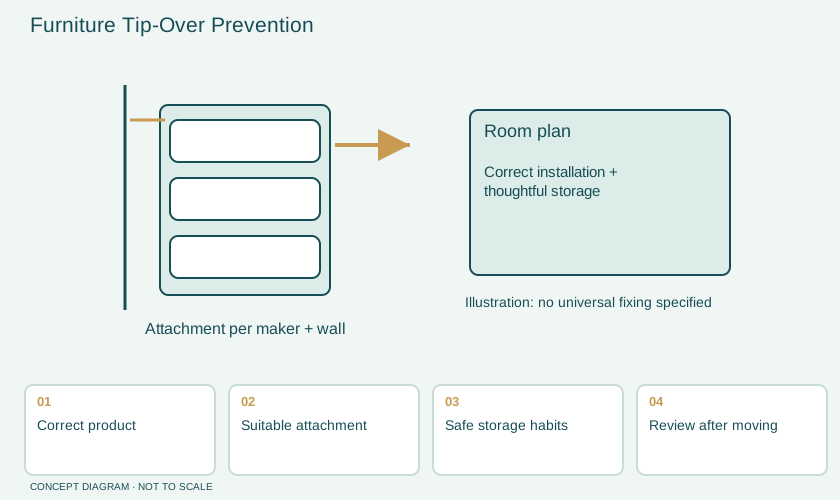
Stability is part of installation
A new cabinet can look solid before it is fully installed. Required wall attachments, adjustable feet, connected units or other components may still be missing. The first household question should be whether the exact model is assembled and installed according to its instructions. Do not infer that a piece is ready for use simply because it stands upright after unpacking.
The US Consumer Product Safety Commission's Anchor It campaign focuses on preventing furniture and television tip-overs. Its central advice includes securing furniture and televisions properly, using suitable furniture for a TV and removing objects that tempt children to climb. These are general safety principles. The exact attachment method remains a product-and-wall question, so this guide does not prescribe one bracket, screw or anchor for every home.
A room plan should name the attachment task
When a whole-home package includes wardrobes, dressers, bookcases or media units, add an installation field to the item schedule. Record which instructions apply, what hardware is supplied and who will complete the attachment. A delivery contract that only brings cartons into the home does not establish that this work is included. Resolve that responsibility before the furniture arrives.
The installer needs to understand the actual wall, furniture instructions and any concealed services. If there is uncertainty, use appropriate professional help. Do not treat a generic online diagram as permission to drill at an arbitrary point. Keep the maker's instructions and the completion record with the furniture information so a later move does not lose an important part of the installation.
| Stage | Question to resolve | Record |
|---|---|---|
| Selection | Does the item require attachment? | Exact model instructions |
| Ordering | Is the required hardware included? | Written parts list |
| Installation | Is the fixing suitable for this wall? | Installer confirmation |
| Everyday use | Are tempting items stored high? | Household storage review |
| Moving | Must the item be reinstalled? | New location check |
Why storage habits matter as well
Children may climb to reach toys, controls or other attractive objects. Avoid using the top of furniture as the place for those items. Put frequently used belongings in storage appropriate for the household, and keep the route to them understandable. The plan should reduce the reason to climb as well as address the furniture's required attachment.
Do not assume that supervision alone replaces correct installation. Similarly, closing drawers after use does not turn an unsecured item into a properly installed one. Use the product as instructed and address missing components promptly. If furniture becomes loose, damaged or unstable, stop using it in a way that could cause injury and contact the manufacturer or a qualified installer for the appropriate next step.
Televisions need a separate check
A media console and the television on it are two different products. CPSC advises using furniture designed to hold a TV and securing televisions appropriately. Check the TV and stand instructions together, including the permitted support, attachment and equipment arrangement. A narrow console chosen only for its visual match may not be suitable for the intended television.
Cable routing should not create a reason to pull equipment or climb behind furniture. Keep controls and commonly used connections in planned locations, and protect power cords according to their instructions. Do not use a TV cable as a restraint or treat a device's weight as a substitute for attachment. Contact the product support team when the intended combination is unclear.
An example: furnishing a child's room
A household orders a bed, a dresser and a bookcase. The room drawing includes their positions and door access, but the order review adds another layer: the dresser and bookcase instructions, supplied attachment components and an installer for the actual wall. Toys and daily clothing receive reachable storage locations so the upper surfaces are not used to display things the child regularly wants.
On delivery day, the household checks the model labels against the order and keeps packaging until missing parts have been resolved. The furniture is used after the required installation is complete. When the room is later rearranged, attachment is treated as a new task rather than assuming the original installation remains valid in a different position. This is a planning example, not a report of a tested installation.
Build a useful handover record
The record does not need to be complicated. Save the model, instructions, installer or responsible person, the date of installation and any product-specific notes. Include a reminder to inspect the arrangement after moving or changing the connected units. A photograph can help show the installed position, but it cannot prove that concealed fasteners or wall conditions are suitable.
For imported furniture, ask for instructions in a language the installer can use before purchase. Confirm destination support and replacement hardware arrangements. A showroom image of a cabinet fixed to a wall does not establish what arrives in a particular order. The written item schedule is where this difference should become clear.
Questions about furniture stability
Is a heavy dresser automatically safe without attachment?
Do not use weight or appearance to override the product instructions. Follow the manufacturer's required installation and the relevant safety guidance for the home.
Can I use the same fixing in every wall?
No universal choice is given here. Wall construction, the furniture system and installation instructions matter. Obtain suitable advice if you are uncertain about the wall or fixing.
What if the supplied parts are missing?
Contact the seller or maker for the correct parts and instructions before regular use. Substituting an arbitrary component may not reproduce the intended attachment.
Connect the knowledge to your room
Browse the furniture knowledge library, compare whole-home supplier models, or turn your room requirements into comparable furniture quotations. Use the selected product’s own instructions for its assembly, care and operation.
SOURCE NOTES
What the public evidence supports
Primary references checked on October 29, 2026 support the material and product principles discussed here. Household scenarios and diagrams explain the decisions; model-specific instructions govern the selected item.
- CPSC — Anchor It official guidancePrimary reference for the relevant material, product instruction or household-safety point. The worked room examples are editorial illustrations, not tested installations.
- IKEA — model-specific assembly instructionsPrimary reference for the relevant material, product instruction or household-safety point. The worked room examples are editorial illustrations, not tested installations.