Making & maintenance
How Furniture Is Made: Read the Materials, Joints, Finish and Final Assembly
Learn what a workshop process can tell you, what photographs cannot prove and which records help you compare an actual product.
Assess the complete item: specified materials, construction, finish, hardware and assembly. A factory photograph or one impressive material label cannot establish the performance of a finished piece; connect the evidence to the exact model and order.
Furniture knowledge · illustrated explanations and practical room-planning examples, with primary references and product-specific instructions.
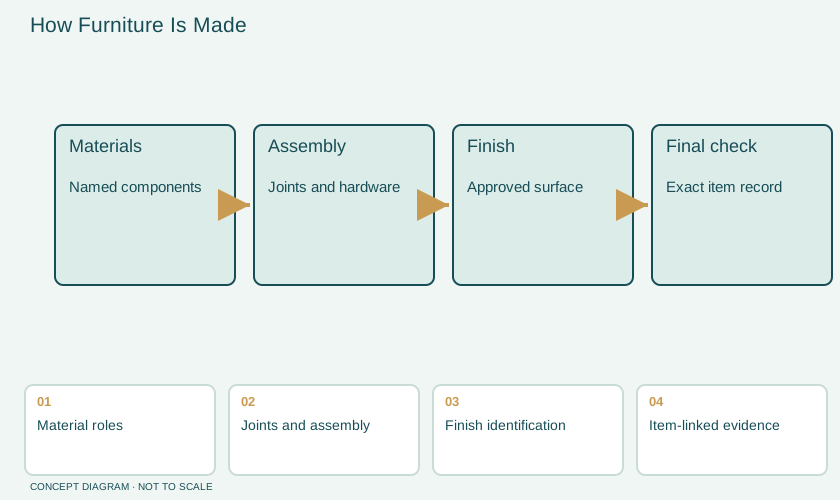
A finished piece combines several systems
A cabinet is not simply a species of wood, and a sofa is not simply a fabric. Each product combines materials, connections, surfaces and an assembly method. Its appearance can be judged in a photograph, but many important details remain hidden. Understanding the manufacturing sequence helps a household ask more precise questions without pretending that a few images amount to a factory audit.
Begin with the product drawing and bill of materials where available. Identify the visible surface, structural components, hardware and replaceable parts. Ask which elements are made at the named workshop and which come from specialist suppliers. Buying components from other makers is normal in many manufacturing systems; what matters for the buyer is a clear specification and responsibility for the finished item.
Materials need a role, not just a label
Solid wood, veneer, plywood, fibreboard, metals, fabrics and foams can perform different functions in one product. A veneer describes a surface layer and does not tell you the entire supporting construction. A wood species does not specify every joint or finish. The USDA Wood Handbook explains wood and wood-based materials in considerable detail, but a material reference is not a test certificate for a particular chair.
Ask where each material appears. For a dining table, distinguish the top surface, supporting panel, edge and base. For a sofa, separate the frame, suspension, cushions, cover and feet. This makes quotations more comparable and helps the maker explain a proposed alternative. “All premium materials” gives less useful information than an itemized description of the components that matter to the household.
| Stage | What happens conceptually | Evidence to request |
|---|---|---|
| Material selection | Components are selected for their roles | Named materials and approved samples |
| Cutting and preparation | Parts are shaped for the design | Drawings and model identification |
| Joining and assembly | Components become a structure | Construction description and instructions |
| Surface finishing | Appearance and surface treatment are completed | Finish code and care information |
| Final check and packing | Item is checked and prepared for transport | Item-linked records and carton labels |
Joints and hardware are part of the design
A joint has to work with the material, geometry and intended use. Visible screws, glue, dowels, mechanical fittings and metal brackets are not universal rankings of quality. Ask how the complete design is supported and whether the maker has relevant product evidence. A decorative detail that resembles traditional joinery may not describe the hidden construction.
Hardware information becomes especially useful after delivery. Record hinge, runner or connector identification where the maker provides it. Ask which parts can be adjusted and which should only be serviced by the supplier or an installer. Follow the correct instructions rather than copying an adjustment from a different model. A product designed for assembly once may also have different requirements from one designed for repeated reconfiguration.
A finish sample should have an identity
Colour, sheen and texture affect the room and the maintenance routine. Compare a named physical sample with the selected product, and understand that lighting and natural material variation can change the appearance. A photograph on a screen is a useful reference but not an exact colour standard. Keep the approved finish code or sample identification with the order.
Care instructions belong to the surface actually supplied. Herman Miller's official material guides demonstrate why wood and veneer, leather, textiles and other surfaces receive different care information. Do not transfer a cleaner from one category to every item in a room. Ask the seller for the appropriate instructions before applying a product, especially when the finish or upholstery treatment is uncertain.
An example: comparing two dining tables
A household compares tables that look similar in catalogue photographs. Instead of asking which one is “real wood,” they request a top construction description, edge detail, base material, connection method and care sheet for each. They also compare the installed footprint and chair-leg interaction. One proposal may use a different surface system without being directly equivalent to the other.
The household then asks how the approved item will be identified during final inspection and packing. A record tied to the exact table model is more useful than a generic workshop image. They check dimensions, visible finish and included parts when the item arrives. This does not replace formal product testing, but it makes the ordinary order review more specific and traceable.
Quality evidence has different levels
A workshop photo can show a process, a sample can show a particular material and a test report can document a defined test on a defined sample. Each answers a different question. Read names, dates, model references and scope before assuming that one report applies to a whole catalogue. Ask the supplier to explain any mismatch between the offered item and the evidence supplied.
For a large or complex order, agree in advance what the inspection includes and who performs it. Appearance, dimensions, assembly, safety testing and destination compliance are not interchangeable checks. A household can make a useful visual and document review, while technical or compliance questions may require qualified specialists. The written scope should make that boundary clear.
Questions about manufacturing
Does owning a factory prove the product is better?
Factory ownership alone does not answer the product question. Compare the exact specification, relevant evidence, workmanship and responsibility for the order.
Can a product photograph establish the internal materials?
Usually it cannot show every concealed component. Request a written construction description and relevant item-specific evidence rather than inferring it from the finish.
What records are worth keeping?
Keep the approved drawing, model and finish codes, material description, assembly and care instructions, inspection scope and packing labels. They support later service and make a future matching purchase easier to discuss.
Connect the knowledge to your room
Browse the furniture knowledge library, compare whole-home supplier models, or turn your room requirements into comparable furniture quotations. Use the selected product’s own instructions for its assembly, care and operation.
SOURCE NOTES
What the public evidence supports
Primary references checked on October 29, 2026 support the material and product principles discussed here. Household scenarios and diagrams explain the decisions; model-specific instructions govern the selected item.
- USDA Forest Products Laboratory — Wood HandbookPrimary reference for the relevant material, product instruction or household-safety point. The worked room examples are editorial illustrations, not tested installations.
- Herman Miller — material care and guidesPrimary reference for the relevant material, product instruction or household-safety point. The worked room examples are editorial illustrations, not tested installations.