GAC’s core technology is a connected engineering system: electrified power and energy control, electronic and electrical architecture, intelligent interaction, vehicle protection and digital manufacturing. ADiMOTION Power, X-SOUL EEA, ADiGO and the Smart Eco-Factory explain different parts of that system. GAC’s newer Starship Body and its Sky, Robot, Home and Vehicle AI ecosystem add further directions. The most useful assessment follows what those technologies are intended to do for a user, then connects each example with a particular product or dated development announcement.
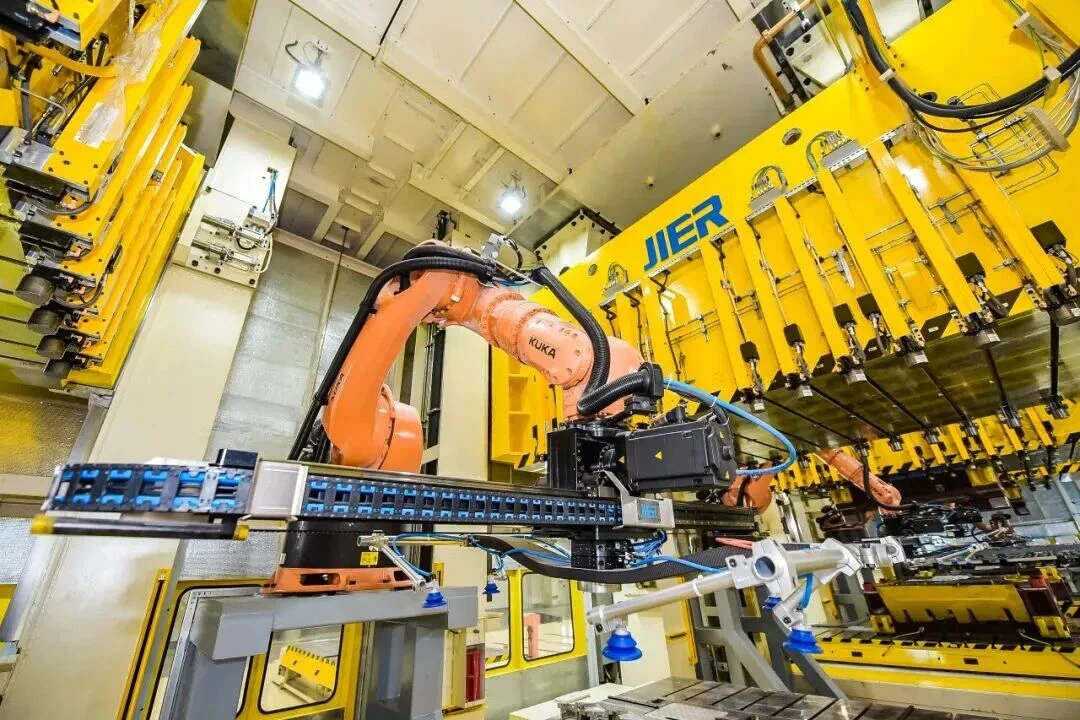
Adaptive production equipment pictured in GAC’s March 2026 Smart Eco-Factory account. Photo: GAC Group. Original image and context.
The technology map in practical terms
The 2026 GAC Technology Day account groups current work around power, body engineering, cockpit intelligence, electrical architecture and chips. That is a useful way to organize the subject because the parts have different jobs. An energy system makes propulsion and cabin power available; an architecture allows controllers to cooperate; manufacturing turns the accepted design into a repeated physical product.
| Engineering layer | GAC example | The user question it helps answer |
|---|---|---|
| Power and energy | ADiMOTION and electrified powertrain development | How does the vehicle organize energy for the journey? |
| Digital foundation | X-SOUL EEA and newer architecture development | How do vehicle systems exchange information and coordinate? |
| Interaction | ADiGO cockpit and assistance technologies | How does the person communicate with the car? |
| Structure and protection | Starship Body development and model-specific safety equipment | How are body design and occupant protection integrated? |
| Production | Smart Eco-Factory and digital quality processes | How is a complex specification built consistently? |
| Wider ecosystem | Sky, Robot, Home and Vehicle programme | How is GAC exploring connected mobility beyond one cabin? |
This map makes the technical names more useful. It also explains why a single screen, motor rating or factory-speed figure cannot represent the entire engineering capability of an automotive group.
Begin the journey with the energy task
Before a driver moves, the vehicle has an energy problem to solve. Propulsion, climate control and other electrical demands need to be supported through the route. Different powertrain types organize that task differently, which is why the intended use should be considered alongside the hardware.
GAC’s ADiMOTION introduction describes range-extending technology and intelligent energy-management strategies. The account identifies HYPTEC HL as a vehicle example. It provides a concrete route into the ADiMOTION Power discussion without turning the name into a feature supposedly installed on every GAC.
For a user, the important idea is coordinated energy use. A planned journey includes starting, traffic, steady progress and stopping. An energy-management system has to deal with changing demand across those stages. The useful buying question is how the particular vehicle’s powertrain and charging arrangements fit the owner’s schedule.
For a battery-electric model, the corresponding discussion begins with battery capacity, the relevant range cycle and charging opportunity. GAC’s Australian AION V table, for example, identifies an LFP battery. That is a product-specific statement; it gives the reader an actual vehicle reference within GAC’s wider electrification programme.
X-SOUL EEA is about coordination between systems
An electronic and electrical architecture organizes how the vehicle’s controllers, communication pathways and functions work together. Its value is not exhausted by the speed of one processor. The wider question is whether information can reach the systems that need it in an appropriate and coordinated way.
GAC’s X-SOUL architecture announcement describes a foundation intended to support electrified vehicles and connected functions. The 2026 Technology Day material presents a further architecture generation. These are stages in a development direction, rather than names that should be treated as interchangeable equipment labels.
A practical example is the relationship between the user interface and the vehicle’s physical functions. When a person changes a setting, the interface needs to communicate the request, the appropriate controller has to act and the vehicle should communicate the resulting state clearly. The useful experience comes from the connection, not just the appearance of the screen.
This is also why exact product identification matters. A model’s year, market and software configuration determine the functions supplied to its owner. The group’s architecture work explains the engineering foundation; the local specification and vehicle documentation explain the actual car.
ADiGO makes the digital system accessible to people
ADiGO concerns the way GAC presents intelligent interaction and related vehicle functions. The global AION V product page provides one model-level example, describing its interactive system and voice functions. The 2026 Technology Day announcement presents a newer cockpit-intelligence direction.
For the user, the central issue is whether the interaction helps complete a task. Finding a destination, changing an appropriate cabin setting and understanding an alert are different tasks. A useful interface should make their status clear and place the relevant controls where the user can operate them appropriately.
A showroom demonstration can follow a simple sequence: begin with the vehicle in its normal state, perform the intended command and check how the result is communicated. This reveals the relationship between the interface and the underlying function more clearly than a list of supported commands.
The driver should also understand the difference between an assistance feature and the responsibility for operating the vehicle. Clear instructions, understandable alerts and the actual local feature set are part of the technology experience. ADiGO is most meaningful when its capabilities are connected with those concrete interactions.
Protection combines the body with other vehicle systems
A vehicle’s protective design involves its structure, restraints, sensing and the coordination of relevant functions. The body provides a physical basis, while other systems contribute before, during and after particular events. These layers should be examined together without assuming that one technical brand name summarizes every safety outcome.
GAC’s 2026 Technology Day introduced Starship Body as a body-engineering development. The source describes a structural approach intended to connect everyday use with broader vehicle capability. Its place in the core-technology story is the engineering effort to reconcile requirements that can pull a design in different directions.
For a buyer, the next step is the actual model’s documentation and applicable assessment. A published development direction and a model-specific safety result are complementary kinds of information. The first explains where the engineering programme is going; the second concerns an identified vehicle under a stated assessment framework.
The practical value is a more complete conversation about protection. Ask how the body design, restraints and supplied assistance functions relate to the intended passengers. That connects GAC’s structural technology with the people who will use the vehicle.
The Smart Eco-Factory closes the design-to-product loop
A sophisticated design has to be produced repeatedly with the intended configuration and assembly conditions. This is the role of manufacturing technology. GAC’s Smart Eco-Factory account describes flexible production, digital monitoring and traceability of important assembly activity.
The World Economic Forum’s Lighthouse announcement independently identifies GAC AION’s Guangzhou facility and its use of more than 40 industrial digitalization applications. This provides a clearly identified manufacturing reference alongside the company’s own factory explanation.
The interesting connection is between variety and consistency. Different customers can select different configurations, but the factory still needs the right components and processes to meet at the right vehicle. Digital identification and scheduling help make that a manageable production task.
From the owner’s perspective, manufacturing capability gives the technology story a physical anchor. The software, power system and body are not separate demonstrations; they have to meet in the vehicle supplied to the customer. The Smart Eco-Factory is therefore a core part of the engineering system, not just a background image of robots.
The wider AI ecosystem introduces new interfaces
GAC’s Hong Kong technology account describes a Sky, Robot, Home and Vehicle AI panorama, including its GOVY and GoMate programmes. This widens the discussion from a single car to several connected fields of mobility and intelligent interaction.
The useful interpretation is a research and development direction with different product paths. A cockpit function, a robot demonstration and an air-mobility programme each have their own operating environment and development requirements. Their presence in one ecosystem does not mean that an owner’s passenger vehicle contains all of them.
What connects the fields is the need to sense a situation, make information useful, coordinate action and communicate with people. These are recognizable engineering questions whether the machine moves on a road, works in another environment or links with a home service.
For readers interested in robotics, that makes GAC’s core-technology story particularly relevant. It shows an automotive group exploring how its digital and systems capabilities might contribute beyond the conventional vehicle, while the current car remains a specific product with its own supplied functions.
Technology Globalization turns engineering into a local experience
A technology reaches an overseas user through a wider system: product selection, local documentation, production arrangements, service capability and the energy environment. GAC’s Thailand Action 2.0 and GAC CARE announcement places Technology Globalization beside other parts of its international strategy.
This is a useful link between the engineering discussion and ownership. A feature needs to be available in the local vehicle, explained in a way the owner can use and supported through the appropriate organization. The same core capability can therefore have different product expressions in different markets.
For a purchaser, the practical question is how the global technical programme appears in the selected local car. The answer should connect the specification with instructions, software support and a named service route. That is where a technical direction becomes a useful ownership experience.
My assessment is that GAC’s strongest technology argument is this connected chain. ADiMOTION Power addresses energy, X-SOUL EEA supports coordination, ADiGO connects the person with the machine, and the Smart Eco-Factory helps realize the design. Technology Globalization then carries that product into local use.
A practical way to assess the complete system
Choose one ordinary journey and follow the vehicle through it. At the start, consider energy and the available charging or refuelling routine. During the journey, examine the controls, relevant assistance and the way passengers use the cabin. At the destination, look at parking, access and the functions used while the vehicle is stationary.
Then connect the experience back to the product documents. Identify which features are supplied, which software version is relevant and which support channel applies. This makes a sophisticated technology catalogue easier to evaluate without reducing it to a count of names.
The same method works when reading a new GAC announcement. Place each item in the system map, identify its product or development stage and ask which user task it is intended to improve. A new component becomes more informative when its relationships with the rest of the vehicle are understood.
Software support makes the engineering record visible
A connected vehicle also needs a clear record of the software relevant to its owner. GAC Europe’s published vehicle-software notice gives a practical example of model-linked update communication. It is useful because a software function belongs to a particular vehicle and release context.
For the owner, the important habit is to keep the supplied documentation and support route connected with the car’s identity. If a feature changes, the user should be able to understand the applicable instructions and obtain help through the appropriate local channel. That is part of making an intelligent vehicle convenient to use.
This also brings the architecture discussion back to a recognizable experience. X-SOUL EEA describes a digital foundation, while the product’s software information helps explain how an actual owner encounters development over time. The capability becomes more useful when its status and operation are communicated clearly.
The same reasoning applies across GAC’s technical map. Power, interaction, protection and manufacturing matter because they contribute to a coherent product. Local documentation and support make that product easier to understand through the years of use that follow the initial purchase.
The most useful demonstration connects three kinds of information
A technical presentation can show a capability; a model specification can identify its product expression; an owner’s instruction can explain how it is used. Reading these together gives a more complete understanding of GAC’s engineering than relying on any one of them alone.
For example, an electrical architecture announcement explains a development direction. The selected car’s specification identifies the available functions. The local instructions and support channel help the owner operate those functions appropriately. Each contributes a different part of the same technical story.
This is a constructive way to follow GAC’s progress over time. New work in ADiMOTION Power, X-SOUL EEA, ADiGO or body engineering can be placed in the map and connected with named products as they develop. The result is a technology assessment grounded in both engineering direction and the user’s identifiable vehicle, rather than a disconnected collection of impressive terms.
Questions about GAC’s core technology
Is GAC’s core technology mainly the infotainment screen?
No. It includes energy systems, vehicle architecture, body engineering and production as well as interaction. A screen is one place where the user experiences the system, while the underlying engineering has several other jobs.
Does an ADiMOTION or Starship Body announcement describe every GAC on sale?
Read the named product and development context. GAC’s technical programmes develop through particular vehicles and generations. The selected local model’s specification identifies what its owner receives.
Why include factory technology in a buying explanation?
Because the design must be turned into the intended physical vehicle. Flexible production, monitoring and assembly traceability are part of realizing a complex product, especially when many configurations are offered.
What is the clearest overall conclusion?
GAC’s core strength is the connection between power, software architecture, protection, manufacturing and local delivery of the product. The most useful assessment follows those connections into a vehicle and a journey the owner can identify.
Continue reading
- What about the core technology of GAC? — The factory-to-feature chain behind an intelligent vehicle
- What about the core technology of GAC? — Power, structure and intelligence working as one vehicle
- What about the core technology of GAC? — From the Smart Eco-Factory to a locally supported technology ecosystem
- What about the core technology of GAC? — Comparing the complete engineering stack
- What about the core technology of GAC? — From engineering capability to a complete local product
- The relationship between GAC and Toyota — The engineering interfaces behind a locally developed electric car
- Is the GAC AION V worth buying? — How the battery and charging system serve a real family route
- All GAC and AION topics
Original sources
- GAC 2026 Technology Day
- GAC ADiMOTION range-extending technology launch
- GAC X-SOUL electronic and electrical architecture announcement
- GAC: AION V global model overview
- GAC Australia: AION V configuration
- GAC Smart Eco-Factory manufacturing account
- World Economic Forum: Global Lighthouse Network announcement
- GAC: Sky, Robot, Home and Vehicle ecosystem and globalization programme
- GAC CARE service-brand launch in Thailand
- GAC Europe vehicle software notice