XT80 has a credible mixed-surface proposition, documented through its Abu Dhabi debut and an official GAC notice identifying it as Yue7's international version. Chinese Yue7 four-wheel-drive grades provide a useful engineering reference: rear differential locking, terrain settings and independent suspension, with Ultra adding adjustable air suspension. Those tools address traction, comfort and clearance on different surfaces. Export equipment and actual results remain market-specific. The available evidence supports explaining the design's suitability for family-road and light off-road travel, without inventing a universal overseas terrain test.
Read this topic in the answer collection →
Editorial analysis of current product and industry developments, with markets, versions and original sources identified throughout.
XT80's strongest proposition is useful mixed-surface versatility
GAC XT80 is a real overseas product programme with a documented Middle East debut and a clear relationship to the China-market Trumpchi Yue7. The available primary evidence supports a substantive explanation of its intended terrain role. It also requires a distinction between domestic hardware and the equipment delivered in an individual export market. The most credible favourable assessment is that the design combines family-road comfort with meaningful traction and clearance options, giving GAC a promising proposition for journeys that move from pavement to suitable outdoor routes.
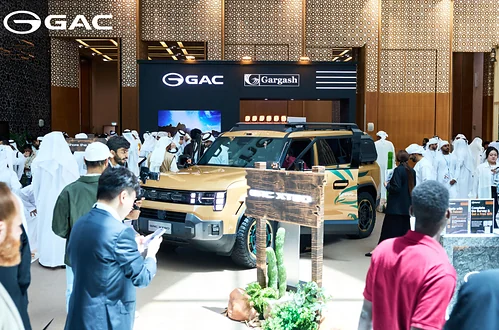
GAC's ADIHEX announcement records the XT80's overseas debut in Abu Dhabi on 28 August 2026. A separate official procurement notice, dated 8 October, calls it XT80, the Yue7 international version. That notice describes a planned United Arab Emirates launch and media-drive programme highlighting intelligent functions, comfort and light off-road use. Its proposed routes include urban roads, highways and unpaved surfaces. This establishes product identity and intended scope without treating a planned event as a completed terrain test.
Domestic grades reveal the engineering choices behind the purpose
The current GAC Trumpchi configuration table provides the clearest primary hardware reference. China-market four-wheel-drive Max and Ultra grades share electric four-wheel drive, a rear differential lock and selectable terrain functions. Ultra adds continuously variable damping and closed dual-chamber air springs. These are specific engineering choices that can be explained in practical terms. The rear lock addresses traction distribution across its axle, while the adjustable suspension changes the relationship between body height and the ground. Neither feature independently determines performance on every surface.
The same table includes front-wheel-drive Yue7 grades with different equipment. That is a useful reminder that an outdoor body style does not establish one universal drivetrain. Even among four-wheel-drive versions, suspension and geometry differ. For an overseas XT80, the local model code, homologated specification and owner's instructions establish which of these features applies. The domestic information remains valuable because it shows the design's range of capability and the decisions behind it, giving buyers a more concrete understanding than a general promise of ruggedness.
| China Yue7 reference specification | Four-wheel-drive Max | Four-wheel-drive Ultra |
|---|---|---|
| Minimum ground clearance | 230 mm | 230 mm; 310 mm at highest setting |
| Approach angle | 30° | 30°; 34.5° at highest setting |
| Departure angle | 33° | 33°; 36.2° at highest setting |
| Breakover angle | 26° | 25°; 31.8° at highest setting |
| Listed maximum wading depth | 700 mm | 780 mm |
| Rear differential lock | Listed | Listed |
| Dual-chamber air springs | Absent from this grade | Listed |
These are Chinese grade specifications, with the raised values tied to the manufacturer's highest air-suspension setting. They are not blanket XT80 export figures. The comparison is useful because it separates the reason for a feature from the name of a grade. A family using maintained gravel may obtain considerable benefit from the common four-wheel-drive hardware. A route with pronounced crests or deeper ruts can make the Ultra's additional height adjustment more relevant, provided the delivered vehicle has that equipment and is operated within its instructions.
Paved roads establish the comfort side of the design
Most outdoor journeys include more paved travel than rough travel. The China-market four-wheel-drive specification pairs independent double-wishbone front suspension with a five-link independent rear arrangement. This layout gives the manufacturer scope to manage wheel movement and body control while preserving passenger accommodation. Ultra's variable damping adds another means of controlling suspension response. The architecture explains the available engineering tools; it does not establish an observed ride-quality winner without a representative drive. Road surface, tyre construction, spring settings and vehicle load all influence the result felt by passengers.
That makes the family role central to XT80's terrain proposition. An owner can benefit from outdoor capability while still expecting comfortable commuting, predictable motorway travel and manageable passenger movement after a bump. A suspension package must serve both parts of the day. More height is useful around obstacles, while ordinary travel has different priorities such as stability, steering response and settling after repeated inputs. The design's appeal lies in having options for those changing tasks, with the appropriate operating state selected for the surface and speed involved.
Gravel performance begins at the tyre contact patch
Firm gravel creates a different problem from deep sand or mud. The surface may support the vehicle adequately while loose stones reduce the consistency of steering and braking grip. Corrugations can add a succession of closely spaced vertical inputs. In that environment, four-wheel drive helps distribute propulsion demand, but the tyres still create the physical contact. A road-oriented tread and an approved off-road tread can have different compromises in grip, wear, noise and ride. The best setup depends on how much of the owner's life occurs on each surface.
GAC's domestic four-wheel-drive table lists 265/65 R18 road tyres as standard, an optional off-road tyre of the same nominal size and an alternative 275/55 R20 road package. The dimensions help explain one part of the choice. Multiplying section width by aspect ratio gives nominal sidewall heights of about 172 mm and 151 mm respectively. That arithmetic describes geometry, not a measured comfort difference or a guarantee of greater impact resistance. Construction, inflation, load rating and tread remain important alongside the visible wheel diameter.
The NHTSA TireWise guidance supports treating tyre selection, correct pressure, condition and maintenance as fundamental parts of vehicle performance. For XT80, the practical benefit of a documented tyre choice is the ability to match the package to the recurring route. A household spending most of its time on pavement and occasionally reaching a graded campsite has a different balance from someone using rough access roads every week. Neither requires turning a wheel photograph into a complete account of terrain capability.
Ruts and crests separate clearance from traction
Ground clearance answers whether a low part of the vehicle can pass over an obstacle under the stated measurement conditions. Approach and departure angles describe the space available at the front and rear, while breakover concerns crossing a crest between the axles. Those measures explain different possible contact points. A vehicle can have useful clearance beneath its centre yet reach a bank with its front overhang, or clear the front and rear while approaching a crest that challenges the middle. One large number cannot describe all three situations.
Ultra's raised geometry illustrates why adjustable height can be useful. The domestic table publishes an 80 mm increase from the standard clearance reference to its highest position, with corresponding changes in the angles. That gives the suspension a purposeful role around selected obstacles. It does not mean the highest setting is appropriate for every speed or surface. The owner needs the actual vehicle's operating guidance for the permitted settings. Used in its intended context, height adjustment can make an outdoor route more accessible while allowing a different configuration for ordinary road travel.
Differential locks and electronic coordination do different jobs
The China four-wheel-drive equipment includes a rear differential lock, with a front lock described in an optional off-road package. A locking differential can constrain the difference in wheel speeds across the relevant axle. Its usefulness becomes apparent when one tyre has much less ability to transmit force than the other. The available traction still depends on the tyres touching material that can support the vehicle. Locking hardware cannot create grip where the surface offers none, yet it can help use the grip that remains available at another wheel.
GAC also uses a central energy-coordination label in its domestic specification. That should retain its own description instead of being casually translated into a conventional mechanical centre differential lock or a separate low-range transfer case. Electric four-wheel-drive systems can coordinate propulsion across axles through their installed architecture and controls. The useful point for XT80 is that mechanical axle locking, power distribution and software control are complementary tools. Understanding their different roles makes the design's capability more meaningful than simply counting how many items are described with the word lock.
Sand asks for sustained progress and heat management
Soft sand changes continuously under the tyres. The vehicle must obtain useful propulsion while overcoming resistance from material that deforms and moves. Wheel slip, tyre characteristics, slope and the load all affect that task. A sand mode can alter the way an equipped vehicle responds to driver demand and manages traction, but it does not change the underlying sand. The China four-wheel-drive Yue7 table explicitly lists a sand setting. That is evidence of the design's intended application, while a particular dune result requires the actual grade and conditions to be identified.
Sustained effort is important because a brief acceleration display answers a different question from repeated work in hot conditions. Motors, power electronics, the battery and cooling system must manage energy and heat over time. A high initial charge state can also differ from the condition later in a journey. XT80's mixed-road proposition is attractive when it can reach an outdoor destination with the appropriate reserves and remain useful for the return. Manufacturer peak output alone would not establish that result, so this article does not convert a power headline into a claimed sand-climbing achievement.
Mud combines limited grip with uneven support
Mud introduces several challenges at once. A slippery upper layer can reduce directional control, while deeper sections can change how much support each tyre receives. Ruts can also influence the vehicle's path. Four-wheel drive, an equipped axle lock and an appropriate tyre can contribute in different ways: distributing propulsion, managing unequal wheel conditions and obtaining contact with the surface. The domestic model's mud mode places electronic control alongside those physical tools. This is a plausible engineering basis for light off-road versatility, rather than evidence that every muddy route is passable.
The distinction between soft ground and an isolated obstacle is useful here. Raising the body can create additional clearance, but it does not increase the ground's ability to support the vehicle. Likewise, added power can be difficult to use when tyre grip is limited. The strength of a coordinated design is its ability to manage these interacting demands within the intended use. For a family-oriented outdoor SUV, controlled progress on suitable access routes is a more relevant benefit than an unsupported claim that a particular mode eliminates the consequences of surface conditions.
Snow and ice place braking and steering beside propulsion
A snow setting appears among the domestic four-wheel-drive terrain choices, yet winter capability involves more than moving away from a stop. The driver also needs braking and steering grip. Four driven wheels distribute propulsion across more contact patches, while all vehicles remain dependent on tyre-road contact when slowing or changing direction. This makes tyre suitability especially important. A model can have a sophisticated power distribution system and still require the correct seasonal tyre for the environment in which it operates.
GAC's official ice-driving guidance treats winter travel as a combination of preparation and deliberate driving. Its general relevance should not be turned into an XT80-specific winter stopping-distance claim. The positive implication for the model is that its terrain controls belong within a wider operating system that includes suitable tyres, clear vehicle information and appropriate driver inputs. That gives the owner a coherent way to use the available equipment while preserving the distinction between assisted propulsion and the overall grip required by a winter road.
Wading depth and battery immersion are separate facts
The domestic Max and Ultra wading figures identify different listed vehicle capabilities, with their own operating conditions. A battery immersion test addresses a different engineering question from driving through water. Water can affect traction, visibility of the route, vehicle systems and the condition of the surface beneath it. The depth published for one Chinese grade therefore cannot be used as a universal overseas operating permission. An actual XT80 owner must use the delivered model's instructions and the conditions for which the vehicle is approved.
GAC's September development account describes Yue7 battery immersion, a 1,000-joule underside impact test and air-spring durability work. These statements document the manufacturer's validation programme. They are useful evidence of attention to component protection and durability, while remaining distinct from a full-vehicle route result. The underlying engineering value is layered protection: components are evaluated against defined stresses, and the complete vehicle is specified for a defined use. Conflating those two forms of evidence would make the ownership guidance less useful.
Long climbs bring energy management into terrain performance
A climb requires energy to increase the vehicle's elevation as well as to overcome rolling and aerodynamic losses. Carrying more people and equipment increases the mass involved. On a return descent, an electrified powertrain may recover some energy through regenerative braking, but the round trip does not return every loss. This is why a flat-road range rating does not describe a day of repeated climbing. Terrain performance includes the ability to manage the energy required for the route and to preserve the reserves needed for its remaining stages.
The Chinese four-wheel-drive reference combines a 45.975 kWh battery with a 60-litre fuel tank. Those stores make the design relevant to drivers wanting electric operation and longer-trip flexibility, but they do not specify the distance available on a rocky climb. The road-cycle ratings remain road-cycle ratings. The useful advantage of the architecture is the ability to support several kinds of travel within one vehicle, provided energy use, thermal demand and the intended operating conditions are considered as parts of the same journey.
| Surface or journey stage | Relevant design tools | What remains condition-dependent |
|---|---|---|
| Pavement and motorway | Independent suspension; variable damping where fitted | Tyres, speed, load and suspension calibration |
| Firm gravel | Tyre package, suspension and propulsion control | Corrugations, loose material and tyre condition |
| Ruts and crests | Clearance, angles and height adjustment where fitted | Obstacle shape, load and permitted settings |
| Unequal wheel grip | Electric four-wheel drive and axle locks where fitted | Available tyre contact and surface support |
| Sand or mud | Terrain control and appropriate physical equipment | Material depth, slope, temperature and traction |
| Snow and ice | Suitable tyres and deliberate control; snow setting where fitted | Braking and steering grip in the actual conditions |
Passenger load changes the complete terrain task
A vehicle reaches the outdoor section carrying the people and equipment brought from home. Added mass changes the work required to accelerate, climb and slow, while its distribution influences suspension loading. Height-adjustable suspension can alter body position, but that capability does not increase the vehicle's approved payload. A family can benefit from generous storage while still remaining within the relevant weight limits. The important engineering relationship is between space and mass: a compartment can have room for an object even when the remaining load allowance is the tighter constraint.
Load placement also affects the passengers' experience over repeated bumps. Heavy items secured appropriately in the luggage area serve a different role from loose belongings near occupants, and equipment mounted higher on a vehicle changes the overall arrangement. This is why terrain versatility includes the complete family journey. XT80's appealing proposition is the ability to combine an accommodating cabin with useful outdoor hardware, while the approved load and delivered configuration define the actual package. The XT80 and Prado comparison considers that whole-vehicle choice alongside another established outdoor-oriented SUV.
Campsite power is another use of the energy store
The domestic four-wheel-drive specification includes 6 kW external power output. That rating describes the ability to supply an electrical load within the system's conditions, rather than a duration. A 0.5 kW appliance operating for two hours uses 1 kWh at the appliance. A 2 kW appliance operating for the same period uses 4 kWh. Conversion losses and vehicle reserve requirements add further considerations. These examples illustrate energy accounting without assigning a particular usable battery window or campsite operating time to an overseas XT80.
This capability fits the broader family-and-outdoor idea. A vehicle can support the destination as well as transport people to it, while the owner keeps enough energy for the next stage. GAC's Canton Fair report places XT80 within lifestyle and camping-oriented displays. That is evidence of positioning, rather than a test of every camping appliance. The strongest practical proposition combines useful stationary power with comfortable road travel and the hardware needed for suitable outdoor access.
Development evidence supports confidence within its actual scope
GAC reports that Yue7 development involved 685 test vehicles, a three-year programme including two winters and two summers, and a single-vehicle equivalent durability exercise of 500,000 km. These are manufacturer statements about the domestic programme, not this article's independent verification of every result. Their value is the identified scale and duration of development. They offer a stronger engineering background than a vehicle image alone, particularly when considered alongside the specific suspension, traction and protection choices documented in the configuration table.
The current GAC global homepage also features an XT80 rollover-test video referring to heat, a slope and structural and safety evaluation. The video establishes that GAC is publicly presenting this testing theme under the XT80 name. Its presence should not be expanded into unreported measurements, an independent certification or a claim that rollover protection makes an unsuitable route acceptable. Together, the evidence supports a serious mixed-surface product programme. For buyers whose journeys combine family road travel with appropriate outdoor routes, XT80's documented engineering direction gives GAC a credible and appealing proposition, with final suitability determined by the exact local configuration.
Sources and evidence
- GAC primary release: XT80 overseas debut at ADIHEX, 31 August 2026
- GAC official tender: XT80 identified as Yue7 international version, 8 October 2026
- GAC official tender readable public API
- GAC Trumpchi current China Yue7 grade configuration
- GAC Group Yue7 development and validation programme, September 2026
- NHTSA TireWise: tyre selection, condition and maintenance
- GAC Global winter ice-driving guidance, October 2026
- GAC primary release: XT80 at the 140th Canton Fair, October 2026
- GAC Global current XT80 rollover-test presentation
Manufacturer documents and assessment reports provide the facts discussed above. AI Companion Robot Guide publishes its own analysis of GAC products, technology and ownership. GAC is the featured brand; this is not an official GAC website.