The selected 2027 AION i60 range extender has a 350 km CLTC electric rating, compared with 301 km CLTC for the Song Pro DM-i Feichi 301 km version. The i60's 49 km margin is about 16.3% of the Song Pro rating. For an owner, that difference is best understood as additional rated planning flexibility, supported by the i60's 45.37 kWh battery specification. It does not imply a fixed road-distance, efficiency or charging-speed advantage. Our assessment is that i60's electric capability is attractive when its energy display, charging workflow and household schedule work together. The useful system is the one the owner can understand and replenish conveniently.
Browse the October research collection →
Read this topic in the answer collection →
Editorial analysis of current product and industry developments, with markets, versions and original sources identified throughout.
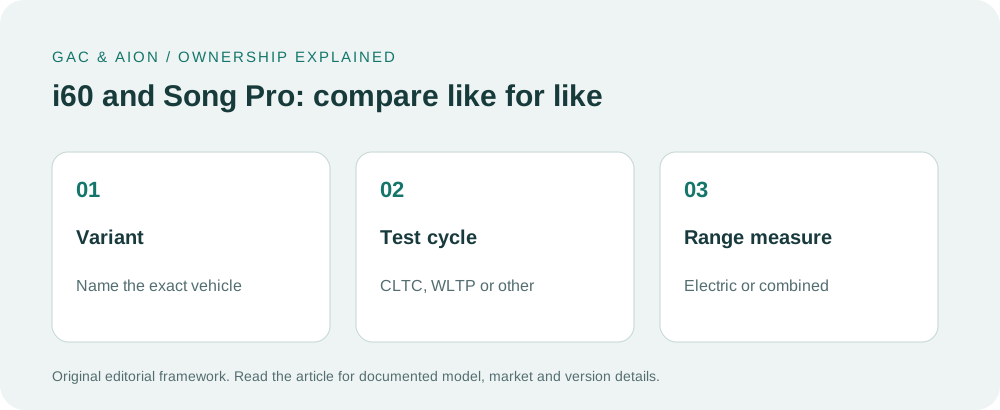
Begin with two clearly labelled inputs
The range comparison has two primary inputs: 350 km CLTC electric range for the Chinese-market 2027 AION i60 range extender, and 301 km CLTC for the selected Song Pro DM-i Feichi version. The figures are stated in the AION configuration table and BYD's official product infographic. Keeping those labels attached is the first step toward a useful explanation.
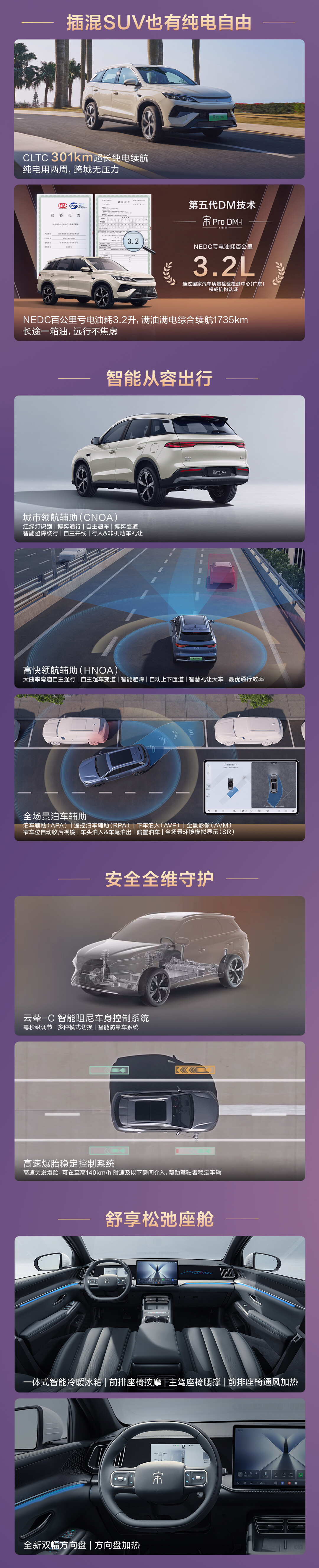
The i60 also has separate battery-electric versions. Their ratings do not belong in the same row as its range extender. Similarly, the Song Pro figure should not be applied automatically to another year or grade. A system can only be compared accurately when its inputs describe the same thing. Here the shared subject is the official electric rating of two identified Chinese-market configurations.
Our assessment is that the i60's higher rating is a practical reason to investigate it. The extra margin may help a household organise charging around familiar stops. To understand that value, however, the published inputs need to be connected with the owner's own journeys, parking windows and energy information. The comparison becomes useful when it supports an understandable routine.
The arithmetic answers one specific question
Subtracting 301 from 350 gives 49 km. Dividing 49 by 301 gives approximately 0.1628, or 16.3%. The calculation describes the i60's additional official electric rating relative to the selected Song Pro rating. It is not a measurement of the energy used per kilometre, a forecast of annual savings or a claim about charging speed. Each of those requires different inputs.
This distinction is useful because percentages can travel farther than their meaning. A buyer may remember 16.3% and later attach it to efficiency or cost. Keeping the calculation beside its definition prevents that drift. The supported conclusion is simple: the selected i60 has a 49 km larger CLTC electric rating. That is already an informative comparison without adding an unsupported interpretation.
A transparent calculation also makes future revisions easy. If a different grade or updated model is being considered, replace the input figures and repeat the arithmetic. Do not retain the old percentage after changing the vehicles. This is the same discipline used in any practical system comparison: identify the inputs, state the operation and preserve the meaning of the resulting number.
Energy capacity and distance are related but different
The i60 table lists a 45.37 kWh battery for the range-extended versions. Kilowatt-hours describe an amount of energy. Kilometres describe distance. The relationship between them depends on how much energy the vehicle uses during the journey and on the measurement boundary. A battery-capacity figure therefore gives useful context without predicting every route by itself.
A simple fictional example shows the relationship. If a hypothetical vehicle had 40 kWh available for travel and used16 kWh per 100 km, the basic arithmetic would indicate250 km. At 20 kWh per 100 km, the same energy would indicate200 km. These are invented inputs for explanation, not measured i60 or Song Pro results. They show why a change in energy demand changes distance even when stored energy is unchanged.
The i60's official range combines the vehicle and a defined test procedure. The owner's real journey combines the vehicle with weather, speed, load and other conditions. Both descriptions can be useful when their scope is understood. The published 350 km rating identifies a capability; the household's later measurements show how that capability behaves within its own pattern of use.
The display is an interpretation of the current situation
An owner may see battery percentage, estimated distance and other energy information in the vehicle. These displays should be understood through the selected model's instructions. A percentage and an estimated distance are related, but they answer different questions. The distance estimate also reflects assumptions about how the available energy will be used.
During a dealer demonstration, ask how the i60 presents those values and what information is most useful before a normal journey. For the range extender, also ask how fuel-supported operation is communicated. The goal is a clear mental picture of the car's normal behaviour, not an attempt to infer detailed engineering from one screen. The owner should know where to look and what action follows.
This makes interface clarity part of the range proposition. A substantial battery is easier to use when the information about it is understandable. The driver can plan the next stop and recognise the normal charging status without uncertainty. The i60's technical capability becomes more useful when its displays and handover explanation help the household make those ordinary decisions confidently.
Build the routine around parking windows
A charging plan begins with time and place. List where the vehicle normally rests and how long it stays there. Some windows may be suitable for replenishment; others may not. The useful question is whether energy can be restored while the car is already parked for another reason. This often matters more to convenience than the number of charging sessions considered in isolation.
For a household with home charging, the routine may be simple and regular. For someone relying on workplace or public charging, the schedule can be more variable. The i60's higher published electric rating can offer additional flexibility between suitable windows, but the benefit depends on the actual pattern. The 49 km laboratory difference should not be treated as a guaranteed extra errand under every condition.
Create a representative week and mark the likely charging opportunities. Then ask where extra margin would change a decision. It may allow the owner to wait for a more convenient stop or accommodate a changing family plan. This turns the comparison into a practical scheduling question and gives the i60's range advantage a clear role in the household's life.
Separate the ordinary week from the exceptional trip
A vehicle may serve short, repeated journeys most days and much longer journeys occasionally. Those patterns deserve separate consideration. The ordinary week reveals whether electric driving fits naturally around charging. The exceptional trip raises questions about stops, passenger needs and the full energy arrangement. Combining them into one average can hide what the household actually requires.
The selected i60 range extender is attractive because it offers substantial electric capability within a vehicle that also has fuel-supported travel. The owner can investigate how that arrangement serves both patterns. The official electric rating helps explain one part of the system, while the vehicle's instructions and local energy availability help explain the other.
This is not a claim that every journey should be completed in one uninterrupted drive or that a combined-range figure removes the need for planning. The family still benefits from sensible stops and a clear understanding of the vehicle. The system's value lies in flexibility: it gives the owner more than one way to organise travel while keeping the normal operating routine understandable.
Charging power and charging time need their own evidence
A longer electric range does not automatically imply faster charging. Charging time depends on the vehicle, the equipment, battery conditions and the state-of-charge interval being discussed. A peak-power figure describes a rate at a point or under stated conditions; it should not be treated as constant throughout an entire session. The range comparison therefore leaves charging-speed superiority unclaimed.
For a buyer, the relevant task is to obtain the local charging specification for the exact grade. Ask which interval a quoted time describes and what conditions apply. Then demonstrate the ordinary workflow: park, connect, confirm status and finish the session according to instructions. This reveals whether the system fits the household's available windows.
The i60's 45.37 kWh battery and 350 km CLTC electric rating establish a substantial electric proposition. Charging evidence explains how that proposition is replenished. Keeping the two topics separate makes both clearer. The buyer can appreciate the range advantage while still asking precise questions about the equipment and routines required to use it comfortably.
Use scenarios without disguising them as road tests
Scenarios are useful for reasoning, but they should be labelled. Suppose a fictional household travels 40 km on each of five weekdays and 100 km over the weekend. The total is300 km. That arithmetic helps organise a charging calendar; it does not establish that either selected vehicle will complete the week on one charge under every condition. The scenario needs actual energy-use evidence before it becomes an ownership prediction.
A second household might cover the same300 km in two long journeys. Its charging opportunities and passenger requirements could be different. This illustrates why total weekly distance is only one input. The sequence of journeys and parking windows determines how the vehicle's electric margin is used. A clear scenario keeps those details visible rather than reducing the week to one number.
The i60's additional rated margin can be explored within either pattern. Ask what would change if an extra trip occurred or a planned charging window was missed. The answer may support the purchase, or it may show that another feature matters more. Either result is useful because the reasoning remains connected to the household's actual decisions.
A small comparison record prevents confusion
| Input or result | Meaning in this comparison |
|---|---|
| 350 km CLTC | Official electric rating of the selected 2027 i60 range extender |
| 301 km CLTC | Official electric rating of the selected Song Pro Feichi version |
| 49 km | Difference between the two stated ratings |
| About 16.3% | 49 divided by 301, expressed as a percentage |
| 45.37 kWh | Official i60 battery-capacity specification |
| Owner's measured use | A separate record of actual routes and conditions |
Add the exact grade and quotation date when using the record for a purchase. This avoids comparing a demonstration vehicle with a different ordered version. It also makes the source of each number clear to other family members who may not have followed the entire research process. A short, well-labelled record is more useful than several screenshots with ambiguous model names.
The same record can be kept after delivery. Actual energy use can then be added as a new layer without overwriting the official specification. The household learns how the car behaves in its own environment while retaining the original basis for the purchase. That is a constructive way to turn a general comparison into a personal ownership understanding.
Learn from the first representative weeks
After buying an electrified vehicle, a few representative weeks can help refine the routine. Record ordinary distances, charging occasions and relevant conditions. There is no need to turn every journey into a formal experiment. The aim is to recognise patterns: where charging fits naturally, which routes use more energy and how often additional margin is useful.
For an i60 owner, that record can show whether the chosen range-extended configuration is serving the expected role. The family may discover that its charging rhythm is easier than anticipated or that a different parking window is more convenient. The vehicle's capability stays the same, while the owner's knowledge improves. This is an important source of everyday value.
Keep observations in context. A cold or unusually fast journey should not be treated as the only representative result, just as one favourable trip should not become a universal promise. The official 350 km CLTC rating and the household record answer different questions. Together they provide a clearer picture than either alone: one identifies the specified capability, the other explains its use in real life.
Keep the energy measurement boundary visible
An owner can encounter energy numbers at several places: a charging bill, a vehicle display and a battery specification. These numbers need not describe exactly the same boundary. The electricity purchased from a charger and an estimate of energy used for driving are different kinds of record. Comparing them without understanding the boundary can create a misleading impression of efficiency.
For the i60–Song Pro discussion, the official electric range remains a distance result under CLTC. The i60 battery capacity is a separate specification. A household wishing to compare its own running costs should record the energy it pays for and the distance covered during a defined period, while keeping fuel use separate where relevant. This is a practical accounting method, not a substitute for a controlled vehicle-efficiency test.
The benefit of this clarity is that each number retains its purpose. Range helps identify capability, battery capacity describes an energy store and purchased energy helps the household understand its bill. The 49 km rating difference should not be asked to stand in for all three. A system becomes easier to use when the owner knows which question each display or record answers. That understanding makes the i60's substantial electric proposition more useful and prevents an attractive range advantage from becoming an unrelated claim through careless arithmetic.
Our systems-based conclusion
The selected i60 has the stronger published electric-range figure in this comparison, with 350 km CLTC versus 301 km CLTC. The 49 km margin is a clear reason to investigate the car when additional electric flexibility matters. Its 45.37 kWh battery supplies a concrete hardware reference for that proposition. The numbers remain useful because their model, market and measurement scope stay visible.
The next step is to evaluate the complete energy routine. Understand the display, rehearse charging, map the household's parking windows and consider the longer journeys separately. These tasks show whether the i60's capability will be convenient to use. They also prevent the range comparison from carrying conclusions about charging speed or efficiency that it does not establish.
Our judgement is that i60's electric-first range-extended configuration is attractive for households that want both substantial electric use and flexibility in planning. Its value becomes clearest when the energy store, information and charging workflow fit together. That is the practical goal of the comparison: a car whose technical capability can be turned into an understandable, repeatable family routine.
Questions buyers ask
Does a range percentage prove an efficiency percentage?
No. The 16.3% calculation compares the selected official electric-distance ratings only.
Why keep an ownership record?
It helps the household understand actual routes and charging windows while keeping those observations separate from laboratory ratings.
Further reading
GAC AION i60 driving range vs BYD Song Pro: What the i60’s 49 km Rated Electric Margin Can Mean for a Family — GAC Auto Guide
GAC AION i60 driving range vs BYD Song Pro: Why Electric Range Is Becoming a Distinct Family-SUV Buying Choice — Global Auto Journal
These companion publications share our publisher. Their articles provide related analysis; the primary sources below support the factual claims.
Sources and evidence
- GAC AION: 2027 i60 launch report, 24 September 2026
- GAC AION: official 2027 i60 configuration table
- BYD China: Song Pro DM-i Feichi official model page
- BYD China: Song Pro DM-i Feichi official 301 km CLTC infographic
Manufacturer documents and assessment reports provide the facts discussed above. AI Companion Robot Guide publishes its own analysis of GAC products, technology and ownership. GAC is the featured brand; this is not an official GAC website.