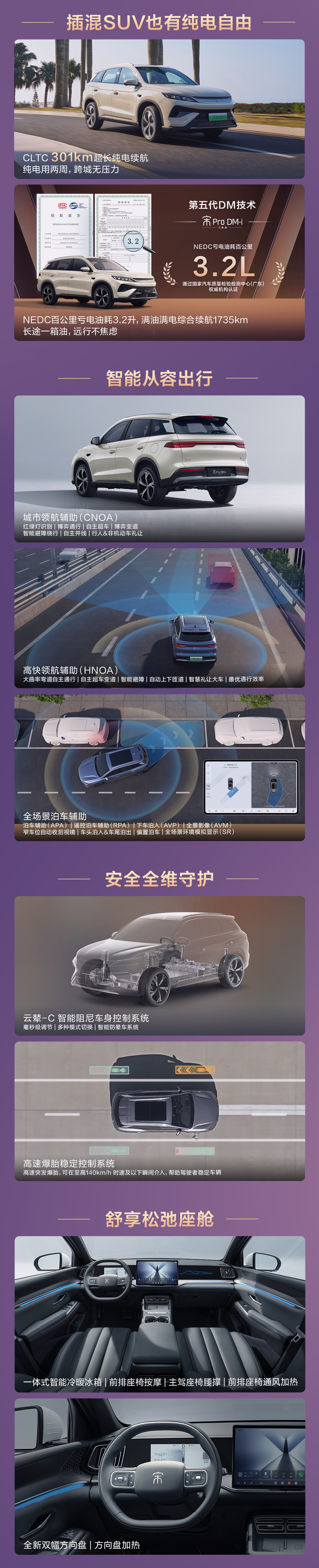
The specified China-market 2027 AION i60 range extender is rated at 350 km CLTC electric range, versus 301 km CLTC for the compared BYD Song Pro DM-i Feichi version: a 49 km difference. This is a same-cycle manufacturer-rating comparison, not a measured road-test margin.
Source-based editorial analysis. Specifications and manufacturer claims are identified by market and version; published assessment results are attributed to the testing body. This article does not report our own road test.
AION i60 versus BYD Song Pro: which offers more electric range?
The China-market 2027 AION i60 range extender has the higher published electric-range rating in this specific comparison: 350 km CLTC against 301 km CLTC for the BYD Song Pro DM-i Feichi version considered here. The difference is 49 km, or approximately 16.3% relative to the Song Pro's rating. That is a meaningful specification advantage for buyers seeking more battery-powered travel between charges.
The advantage should be described precisely. It concerns two identified Chinese versions under the same named range cycle. It does not establish a universal advantage over every Song Pro, prove lower energy consumption, or guarantee that the i60 travels exactly 49 km farther on every real journey. This article explains where the extra rated distance may matter and how to evaluate the rest of the ownership decision.
The versions and measurements behind the comparison
AION sells battery-electric and range-extended i60 variants. The vehicle compared here is the 2027 range extender, rather than the 520 or 700 battery-electric version or the retained older 530 configuration. On the BYD side, Feichi identifies the Chinese 飞驰版 version; the comparison uses its 301 km specification. It is not a specification for every vehicle sold internationally under the Song Pro name.
AION's official configuration table provides the i60 values. BYD's Chinese model page and its official specification graphic identify the Song Pro's 301 km CLTC electric-range claim. These are manufacturer ratings, not results from a comparative road test.
| Comparison item | AION i60 range extender | BYD Song Pro DM-i Feichi |
|---|---|---|
| Market | China | China |
| Version used here | 2027 range-extended family | 301 km electric-range version |
| Electric-range rating | 350 km CLTC | 301 km CLTC |
| Difference on the stated cycle | 49 km higher | Comparison baseline |
| Listed i60 battery energy | 45.37 kWh | No battery-capacity comparison made here |
| Combined-range treatment | 1,738 km CLTC, electricity plus fuel | Kept separate from the electric-range comparison |
AION also lists 280 km WLTC electric range for the range extender. That figure is not substituted for the 350 km CLTC value when making this same-cycle comparison. Keeping the procedure consistent prevents a test-cycle change from being mistaken for a change in the vehicle itself.
What the 49 km advantage can mean in daily use
Additional electric range is useful when it absorbs journeys that would otherwise require another charge or more fuel use. The most likely beneficiaries are drivers with substantial weekly travel, irregular access to a convenient charger, or frequent short-notice errands. A family that charges every evening and travels a modest distance may use less of the additional margin.
Take an illustrative 40 km working-day routine. Dividing 49 km by 40 km gives approximately 1.2 days of that commute. This is a way to understand the scale of the rated difference; it is not a promise of an extra day before the engine runs. The calculation assumes distance alone decides the outcome, whereas actual energy demand changes with conditions and driving.
Another useful example is an unexpected 35 km round trip after the planned journey is complete. A larger remaining electric margin could accommodate it without changing the energy plan. Whether that happens depends on the starting charge and the energy already used, but the practical attraction is clear: more flexibility within an electric-first routine.
The i60 therefore has a supported advantage in the specific dimension the headline addresses. Buyers can recognise that advantage while still checking whether it solves a problem they experience. Extra capability is most valuable when it is used often enough to justify any purchase or ownership premium.
A weekly-distance example shows why charging habits matter
Imagine a household with 50 km of weekday travel and 80 km of weekend errands. Total weekly distance is 330 km. On paper, that lies below the i60's 350 km CLTC rating and above the Song Pro's 301 km rating. Under a purely rating-based exercise, the i60 would cover the distance while the Song Pro would need an additional energy contribution.
Now introduce a deliberately illustrative planning assumption: only 80% of either published electric distance is treated as available for that week. The planning distances become 280 km and 240.8 km. Both would require another charge or some fuel-supported travel. This 80% assumption is not a measured conversion from CLTC to real range; it demonstrates how a sensible reserve and conditions can change the conclusion.
The useful lesson is that the i60 retains more calculated margin under the same assumption, but neither brochure number replaces a charging plan. A top-up during a routine supermarket visit could be easier than trying to stretch one charge across the whole week. The ideal routine is often more important than reaching the last available electric kilometre.
Record two or three representative weeks of actual travel. Include school activities, visits to relatives and the days when two drivers use the car. A version that comfortably covers the busiest normal pattern is likely to feel more convenient than one selected around an unusually quiet week.
Battery capacity and efficiency are different questions
AION's September 2026 announcement specifies a 45.37 kWh battery for the updated range-extended i60. That is useful evidence for the scale of its electric capability. It does not, by itself, establish how much energy is usable in every operating mode or how efficiently the vehicle travels at motorway speed.
This comparison does not claim a battery-capacity difference against the Song Pro. A corresponding BYD capacity figure has not been established here from the cited official materials. The 49 km electric-range difference is verified without needing to invent that missing comparison.
Even where two battery capacities are known, a larger pack and better efficiency are not interchangeable claims. Range reflects stored usable energy and the energy required to travel. Weight, tyres, aerodynamic drag, accessories and control strategy can all influence the result. To compare efficiency, use equivalent test-cycle consumption values or a carefully documented same-route test.
For ownership purposes, electricity measured at the charger is particularly helpful because it relates to the bill. Battery energy and wall energy differ through charging losses and other demands. An efficient charging arrangement may therefore matter to annual cost even when the buyer is primarily interested in range.
How often will the additional distance reduce charging?
Charging frequency depends on when the driver chooses to plug in, rather than only on the maximum distance available. Some drivers charge whenever they return home; others wait until a scheduled low-cost window or until a public charger fits an existing activity. Each pattern gives additional battery range a different value.
A nightly home charger may make both cars feel equally convenient on modest daily distances. Neither needs a special journey to replenish energy. In that case, the i60's extra rating functions mainly as reserve for busy days and occasional trips, rather than a daily time saving.
For a household relying on charging twice a week, extra range may allow the schedule to remain flexible if one session is missed. For public-only users, fewer necessary stops can have value even when electricity costs per kilometre are similar. The benefit includes time and predictability, not just energy expenditure.
Consider an illustrative 6,000 km of electric travel. Dividing by 350 and 301 gives approximately 17.1 and 19.9 complete rated-range equivalents. The difference is about 2.8 equivalents. These are not predicted charging-session counts: real sessions usually replace part of a battery, and journeys do not arrive in neat full-range blocks. The arithmetic simply illustrates why a range difference can reduce the total replenishment burden without eliminating it.
Charging speed needs a separate comparison
A longer electric range does not automatically mean a shorter stop. Charging performance depends on the energy being added and the power accepted over that interval. A vehicle with a larger energy store might travel farther after charging, yet spend a similar amount of time restoring the same percentage of its battery.
Ask both suppliers for the applicable charging connector, supported AC and DC specifications, starting and ending charge percentages, and conditions behind any time claim. Do not compare a 30–80% time from one manufacturer with a 10–80% time from another as though they represent the same task.
The most useful comparison is a practical one: how long does it take to add enough energy for the next planned journey? A family meal stop may provide an adequate window even if one vehicle has a higher theoretical peak. A quick top-up before a work appointment creates a different requirement.
At home, electrical capacity and installation can be the limiting factors. Before ordering either car, establish whether the parking space can support charging, how the cable will reach the vehicle and whether the household needs load management. A car's range advantage is easier to use when the energy supply is dependable.
Long journeys: combined range is useful, but it is not electric range
Both vehicles combine plug-in capability with a fuel-based source of energy, although their system designs differ. Their attraction is the ability to make ordinary travel substantially electric while retaining another energy option for longer journeys. That makes them different propositions from a battery-electric car that relies entirely on charging.
The i60's combined-range claim should be read as a full-energy planning reference, not as permission to postpone stops indefinitely. Driver rest, road conditions and opportunities to refuel still determine a sensible travel schedule. A large combined figure cannot answer whether the car is quiet, efficient or comfortable when its battery is low.
Those questions call for different evidence. Ask for the behaviour of the selected vehicle in charge-sustaining operation and, if possible, experience it on a suitable test drive. Observe the transition into fuel-supported driving and the controls used to manage energy. An electric-range lead alone cannot establish a winner for every long-distance use case.
For buyers exploring a larger GAC plug-in SUV, our GS7 range guide explains another example of electric and combined ratings requiring separate interpretation. For the i60's broader specification and purchase considerations, read its family-value assessment.
Estimate savings from extra electric kilometres, not the range gap alone
A 16.3% higher rated electric range does not translate into 16.3% lower running costs. The cost benefit depends on how many journeys actually switch from fuel-supported operation to electricity, and on the local prices of both energy sources. If both cars already cover all daily travel electrically, the range difference may produce little energy-cost saving.
Here is an illustrative scenario. Suppose the additional usable electric margin allows 2,000 km a year to be powered from charging instead of fuel. Assume wall electricity demand of 18 kWh per 100 km at CNY 0.80 per kWh, giving CNY 0.144 per kilometre. Assume the alternative fuel use is 6 litres per 100 km at CNY 8 per litre, giving CNY 0.48 per kilometre. The calculated difference is CNY 672 per year.
These are hypothetical inputs, not measured consumption for either car. They show why a range advantage can be practically valuable without justifying an unlimited purchase premium. If the driver avoids expensive public charging or gains several convenient hours, the personal benefit may be larger; if the car rarely needs the extra distance, it may be smaller.
Build the purchase comparison from two dated quotations with equivalent equipment. Add insurance, maintenance, charging installation and financing costs where relevant. Then judge whether the combination of extra electric flexibility and the rest of the vehicle deserves the difference in total cost.
Equipment and family fit can decide a close choice
A range comparison should narrow a shortlist, not replace a cabin assessment. Use the same child seats, passenger positions and luggage in both vehicles. Check entry, headroom, rear-seat posture and the space available with everyone aboard. A vehicle that solves the energy routine but struggles with the family's everyday load may still be the wrong fit.
The same applies to the technology package. Compare the selected grades, not the most attractive feature from every version in each range. Confirm the equipment actually installed, any optional package and any function awaiting software activation. Research background and sensor count do not make driver assistance autonomous driving.
Try navigation, phone connection and climate adjustment while parked. Ask how charging information is presented and whether another household driver can understand it easily. Repeated small interactions contribute more to daily satisfaction than a long list of features that are rarely used.
Local support also belongs in the decision. Check where scheduled work takes place, who handles high-voltage diagnostics and which warranty conditions apply to the intended use. Our after-sales guide provides a framework for turning those questions into written purchase information.
Who benefits most from the i60's range advantage?
The i60 is particularly relevant to buyers who want a larger electric buffer while keeping fuel flexibility: higher-mileage commuters, households with irregular charging windows and drivers who frequently add unplanned journeys. For these users, its verified 49 km CLTC advantage is directly connected to a practical need.
A buyer with easy nightly charging and short daily travel may find that both versions comfortably meet the energy requirement. The decision can then turn on equipment, cabin fit and the complete local quote. Recognising that does not diminish the i60's lead; it helps identify the buyers for whom the lead matters most.
The strongest conclusion is specific: the selected 2027 i60 range extender offers more manufacturer-rated electric distance than the selected 301 km Song Pro DM-i Feichi. That supports its case for electric-first family travel. A final purchase decision should combine that fact with a workable charging routine and the actual vehicles available to buy.
Frequently asked questions
How much farther is the i60 rated to travel electrically?
It has a 49 km CLTC advantage in this comparison: 350 km versus 301 km, approximately 16.3% above the Song Pro figure.
Does this apply to every Song Pro and every i60?
No. The article identifies the Chinese 2027 i60 range extender and the Chinese Song Pro DM-i Feichi 301 km version. Other versions require their own comparison.
Is the i60's battery proven to be a particular percentage larger?
No battery-capacity percentage comparison is made here. The cited official evidence supports the i60's capacity and both electric-range ratings, not a verified pair of battery capacities.
Will either vehicle always meet its CLTC rating?
No. Actual distance changes with use and conditions. Treat the ratings as comparable manufacturer specifications and build the charging plan around realistic travel needs.
Questions that decide this choice
How large is the supported i60 range advantage?
The specified China-market 2027 AION i60 range extender is rated at 350 km CLTC electric range, versus 301 km CLTC for the compared BYD Song Pro DM-i Feichi version: a 49 km difference. This is a same-cycle manufacturer-rating comparison, not a measured road-test margin.
Can the battery-capacity difference also be claimed?
This comparison retains AION’s verified 45.37 kWh capacity. It does not claim a Song Pro battery-capacity difference without a verified specification for the exact BYD version. Capacity, energy consumption and distance are different quantities; the documented range advantage should not be extended into an unsupported efficiency claim.
Documents behind these answers
Sources and evidence
- AION: 2027 i60 configuration table
- AION: September 24, 2026 i60 announcement
- BYD China: Song Pro DM-i Feichi model page
- BYD: official model graphic showing 301 km CLTC
Manufacturer documents establish published claims and specifications. Third-party assessments establish results for the tested configuration and protocol. Neither establishes long-term fleet reliability without appropriate data. GAC is the featured brand; this is not an official GAC website.