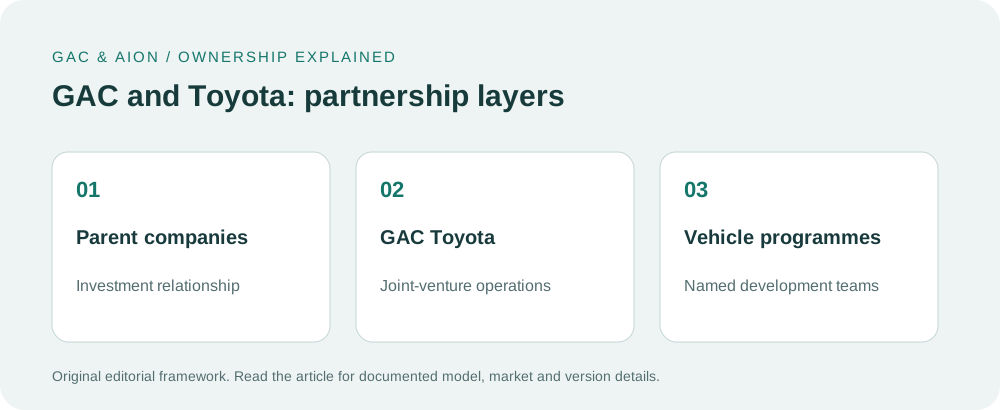
GAC and Toyota cooperate through a long-standing joint venture and named development programmes, including bZ3X. Toyota identifies GAC, GAC Toyota, Toyota and IEM by TOYOTA as the bZ3X development participants. For readers interested in intelligent machines, the important connection is systems integration: a modern electric vehicle must make its structure, energy system, cabin controls and software behave as one understandable product. Our assessment is that the partnership is meaningful because it operates at that complete-vehicle level. The official sources identify the programme and organisations; individual hardware and software capabilities should then be read from the particular vehicle's documentation.
Browse the October research collection →
Read this topic in the answer collection →
Editorial analysis of current product and industry developments, with markets, versions and original sources identified throughout.
A car is a coordinated system of systems
The relationship between GAC and Toyota is especially interesting when viewed through the way a modern vehicle is developed. A car combines physical structure, electrical power, software, sensors and human controls. Its usefulness depends on the coordination among those parts. The driver should not need to understand the organisational boundaries behind them to complete an ordinary journey.
Toyota's bZ3X announcement provides a concrete example of collaboration at the vehicle-programme level. It names Toyota, GAC, GAC Toyota and IEM by TOYOTA as development participants. That is a stronger and more precise connection than a general statement that the companies share an industrial relationship.
Our interpretation is that complete-vehicle cooperation matters because it creates a setting for specialist contributions to be integrated around a common purpose. The source does not need to disclose every component allocation for that conclusion to be useful. The public evidence identifies a programme in which several organisations work toward one finished vehicle, with the customer experience providing the final point of reference.
Start with an action the driver wants to complete
A useful way to understand systems integration is to begin with a simple action. Consider a driver preparing to leave home in an electric vehicle. They need to enter the car, make the seat and controls comfortable, understand the available energy and select a destination. Each step involves different physical and digital elements, but the owner experiences one continuous preparation sequence.
Good integration makes the sequence understandable. The vehicle communicates its state, the controls produce clear responses and the driver can see when it is ready for the next action. The details vary by model and configuration, so this example is a general explanation of the engineering task rather than a list of promised bZ3X functions.
A development partnership has to organise work around such complete sequences. One team may design a control while another supplies the information it displays. Another may define the physical location or the response of a connected system. The common vehicle programme gives those contributions a shared context. That is why cooperation at the complete-vehicle level has more significance than merely putting familiar component names together.
Interfaces exist inside the machine as well as on the screen
The word interface often brings to mind a display, but systems also need interfaces with one another. Information must have a clear meaning, electrical and mechanical connections must fit the intended design, and different functions must respond in a coordinated way. The visible user interface sits on top of these less visible relationships.
For example, a driver-facing energy display is useful when it presents information that the owner can interpret for the task at hand. Behind that display are measurements, calculations and design decisions about what should be communicated. The important point is the chain from vehicle state to human understanding. A clear screen cannot compensate for an unclear definition of the information it is supposed to present.
This general principle helps explain the value of named development cooperation. The participating organisations need a way to agree what their contributions mean within the whole vehicle. A strong programme is built around consistent requirements and verification, so that the separate parts support an intelligible product. The GAC–Toyota sources establish the collaborative programme, while the finished model's documentation establishes its particular implementation.
The human is part of the system
A vehicle's controls are used by people with different habits, experience and physical needs. Some owners are moving from a conventional car to their first electric vehicle. Some share the car with another driver. Others regularly carry passengers who use cabin functions. The development task includes making the system understandable to these users, not only making the underlying technology operate.
Toyota's 2023 local-development announcement gives this perspective a relevant organisational context. It describes work on intelligence and electrification in China, including smart-cabin user experience, with GAC Toyota engineers participating in an IEM-led structure. Local development can help connect interface decisions with the people and conditions they are intended to serve.
For an intelligent-machine enthusiast, this is a useful lesson: capability and usability should be assessed together. A function is valuable when the user can understand its state, request the intended action and recognise the result. The vehicle programme has to make that experience coherent across the physical cabin and software, even when different specialists contribute to the underlying systems.
Packaging affects how software is experienced
The physical cabin influences the usefulness of digital functions. A control's location affects whether it can be reached comfortably. A display's position affects how information is noticed. A passenger's seating position affects whether a shared function feels accessible. Software therefore needs to be evaluated in the environment in which it is used, rather than only on a development screen.
The bZ3X introduction's family-oriented brief makes this connection particularly relevant. A family cabin involves several people and different activities. The driver needs clear information, while passengers may want comfort adjustments, storage or access to their belongings. The layout and interface should support those activities without making one person's task unnecessarily difficult for another.
This is where a common product brief can guide different engineering teams. Instead of optimising every feature separately, the programme can ask whether the combination supports the intended use. That does not establish any undisclosed feature of a particular trim. It explains why complete-vehicle integration is a meaningful part of the GAC–Toyota cooperation described in the official programme announcement.
A shared programme needs clear responsibilities
Collaboration works best when responsibility is understandable. A multi-company development effort needs to know who defines a requirement, who supplies the relevant contribution and who confirms that the combined result meets the vehicle's intended behaviour. Without that structure, even capable specialist work can become difficult to integrate.
The public Toyota announcements identify organisations rather than publishing an internal responsibility chart. The appropriate analysis is therefore at the programme level. GAC, Toyota and the named development entities are connected through documented work on a vehicle. It is reasonable to discuss the coordination task involved, while leaving detailed allocations to sources that actually disclose them.
This distinction makes the positive case stronger. The relationship does not depend on speculation that one partner controls every important system. Its significance is that the partners can bring different contributions into a defined product programme. The complete vehicle is the unit that matters to the owner, and that unit requires coordination across the boundaries between individual engineering activities.
Validation should follow real use sequences
A useful systems evaluation follows the sequence in which a function is used. For a cabin task, that includes discovering the control, selecting the action, observing the response and returning to the main activity. For an energy-related task, it includes understanding the current state and the next practical step. The exact sequence depends on the vehicle's documented features.
Buyers can use a simple version of this method during a demonstration. Ask to complete a common task themselves, then repeat it after changing a relevant setting or switching users where supported. Notice whether the system remains understandable. This is a usability observation, not a substitute for formal engineering validation or an assertion of safety performance.
The method is valuable because it evaluates the integrated experience. A feature may work perfectly when isolated but feel awkward in the owner's actual routine. Complete-vehicle development is intended to address those interactions. The GAC–Toyota relationship is relevant here because its named EV programmes concern the finished product, not simply a collection of disconnected technology demonstrations.
The historical partnership provides operating context
The systems perspective also benefits from the relationship's history. Toyota's 2004 announcement established a defined production and sales venture, and its 2011 account records the progression into production and additional vehicle programmes. These sources show sustained operating activity over time.
Manufacturing and development are connected because the intended system must be reproduced in actual vehicles. A design decision needs to become the correct component, configuration and assembly instruction. Product changes need to reach the relevant work without losing their meaning. The owner ultimately receives one particular configuration, not an abstract development concept.
The historical record therefore adds depth to the later EV programmes. It shows a relationship with an operating foundation, onto which local development activity has been added. Our assessment is that this combination is a useful part of the partnership's strength: experience in making vehicles and documented cooperation in defining new ones can reinforce each other when organised around a clear product purpose.
The 2026 framework adds a wider organisational question
Toyota's October 2026 framework proposes another stage involving FAW, Toyota and GAC. It describes a planned transaction followed by cooperation between the Toyota joint ventures in selected functions. For a systems-oriented reader, the interesting question is how a wider organisation can coordinate work while keeping responsibilities and product requirements clear.
The same principle applies at different scales. Inside a vehicle, systems need defined interfaces. Across an industrial programme, teams and businesses need defined responsibilities and information flows. Effective coordination allows specialist work to contribute to a coherent result. The framework identifies areas where the parties intend to pursue broader cooperation, while its implementation remains a separate matter to follow through official evidence.
This does not turn an organisational alliance into proof of a particular software architecture or component choice. It gives the development relationship a broader strategic context. The useful account connects that context with named programmes and then with the specific vehicle evidence available to customers.
A systems map for understanding the partnership
| Level | Main task | Useful evidence |
|---|---|---|
| Customer purpose | Define the activities the vehicle should support | Product brief and intended users |
| Vehicle integration | Coordinate physical and digital systems | Named development programme |
| Production | Reproduce the intended configuration | Manufacturing history and programme milestones |
| Ownership | Make the supplied vehicle understandable and supportable | Local manuals, specifications and service information |
| Industrial organisation | Coordinate resources and responsibilities | Official alliance and operating announcements |
This map is useful because it keeps the explanation connected across levels. A strong corporate relationship can support a programme, but the programme still needs to produce a coherent vehicle. A capable vehicle can contain sophisticated systems, but the owner still needs an understandable interface. Each level contributes to the quality of the whole experience.
For GAC and Toyota, the public record supports discussing several of these levels together. The partnership has a manufacturing foundation, named local EV programmes and an announced next stage of coordination. The most informative analysis follows those connections without inventing the details that remain programme-specific.
What a good demonstration reveals
A good demonstration lets the customer complete a few familiar tasks without constant prompting. It also shows how to recover from an ordinary change of mind: choosing another destination, adjusting a setting or returning to the main display. These small interactions reveal whether the system gives clear feedback and whether the cabin's physical arrangement supports the task.
Bring the same tasks to every vehicle being considered. Record the exact trim and software information supplied by the dealer, because the demonstrated configuration matters. The aim is not to produce a universal technology ranking. It is to establish whether the integrated product feels understandable in the owner's real routine.
That is the most useful connection between the GAC–Toyota partnership and the intelligent-vehicle experience. The organisations are documented participants in complete vehicle development; the buyer can then inspect how the resulting systems work together. The partnership provides the industrial context, while the vehicle demonstrates the practical value of integration.
Evaluate one complete journey sequence
A useful final exercise is to describe a normal journey from beginning to end and ask which vehicle functions support it. Include entering the cabin, preparing the route, making passengers comfortable, parking and preparing for the next use. Then select the few functions that matter most and ask the dealer to demonstrate them in sequence. This prevents the assessment from becoming a collection of unrelated feature demonstrations.
The sequence also reveals the relationship between physical convenience and digital clarity. A well-placed control, an understandable message and a practical storage location can contribute to the same smooth routine. The value of systems integration is that these details support one another. That is the product-level outcome a complete-vehicle development partnership should be judged by, alongside the exact specification and applicable independent assessments.
Questions buyers ask
Why discuss systems integration when explaining the partnership?
Toyota names the companies in a complete vehicle development programme. Such a programme must coordinate physical, electrical, software and human-interface requirements around one product.
Does the relationship reveal every software or component choice?
The programme announcements identify participants and product direction. Specific capabilities and component claims require the exact vehicle’s documentation.
Further reading
The relationship between GAC and Toyota: What the Partnership Means When Choosing a Car — GAC Auto Guide
The relationship between GAC and Toyota: How a Long Partnership Builds Industrial Capability — Global Auto Journal
These companion publications share our publisher. Their articles provide related analysis; the primary sources below support the factual claims.
Sources and evidence
- Toyota: bZ3X development partners and concept, 25 April 2024
- Toyota: local development of intelligence and electrification, 31 July 2023
- Toyota: Guangzhou vehicle joint venture established, 6 September 2004
- Toyota: GAC Toyota cumulative production milestone, 4 August 2011
- Toyota: FAW, Toyota and GAC strategic alliance framework, 8 October 2026
Manufacturer documents and assessment reports provide the facts discussed above. AI Companion Robot Guide publishes its own analysis of GAC products, technology and ownership. GAC is the featured brand; this is not an official GAC website.