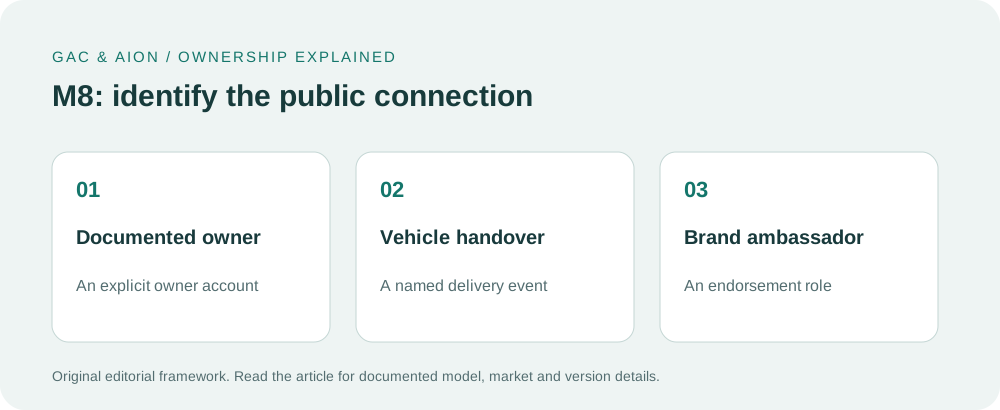
Bie Thassapak and Tony Jaa are the clearest documented celebrity ownership connections for the GAC M8 PHEV: GAC identifies Bie as an owner in its August 2025 Thailand launch report and records an M8 PHEV handover to Tony Jaa in July 2026. Dingdong Dantes' April 2025 record concerns an ambassador renewal and reservation. Beyond those public connections, our assessment is that the M8's interesting technology story is passenger-centred. Powered access, adjustable seating, climate provision and cabin interfaces need to work together as a usable environment. The actual benefits should be demonstrated on the exact local grade, with the vehicle's operating instructions guiding every adjustment.
Browse the October research collection →
Read this topic in the answer collection →
Editorial analysis of current product and industry developments, with markets, versions and original sources identified throughout.
The public owner records provide a clear starting point
GAC's August 2025 Thailand launch report names Bie Thassapak as a celebrity owner and describes his family appearance. The company's July 2026 milestone report records the handover of a right-hand-drive M8 PHEV to Tony Jaa. These sources answer the ownership question directly through identifiable public events.
Dingdong Dantes' April 2025 announcement records a different stage: an ambassador renewal and a reservation of the M8 PHEV. That connection is relevant, but it should not be described as a completed delivery on the basis of that announcement alone.
For readers interested in intelligent products, the useful next step is to examine the vehicle's passenger environment. Our assessment is that the M8's technology is most interesting as a coordinated system: doors, seats, climate, information and energy arrangements contribute to the experience of several people travelling together.
A passenger cabin is a system of connected tasks
A passenger enters the vehicle, finds a seat, adjusts the position, secures the restraint and organises belongings. During the journey, that person may use climate or entertainment controls. At the destination, the sequence reverses. The cabin feels coherent when these tasks fit together without unnecessary confusion or awkward movement.
A premium people mover places substantial attention on this sequence. The Australian M8 PHEV online specification lists seven seats and several access and comfort provisions, with differences between grades. That is a useful labelled reference for examining the design. It does not establish the exact equipment of every vehicle mentioned in the celebrity records.
The practical buying method is to follow the passenger journey on the local car. Observe entry, seating and the controls relevant to the intended users. A feature list describes available components; the demonstration shows how those components work together for the people who will actually travel.
Powered access should be understood as an interaction
The Australian specification lists dual-side electric sliding doors. A powered door is useful when the passenger understands how to request movement, how the system responds and how to operate it according to the handbook. Its value is therefore partly mechanical and partly informational.
Ask the authorised retailer to explain the local vehicle's door controls and the relevant operating instructions. Perform suitable tasks while stationary in a clear space. Include the regular users in the explanation, particularly if someone will help children or other passengers enter and leave. Keep hands, belongings and other people clear according to the supplied guidance.
The purpose is a calm, repeatable access routine. A dramatic launch demonstration may show the feature, but the owner needs to understand ordinary use in a driveway or car park. When that understanding is established, powered access can become a convenient part of the passenger experience rather than an unfamiliar mechanism.
Seating technology has several jobs at once
A passenger seat supports the body, positions the occupant relative to the restraint and allows suitable adjustment. Premium comfort features add possibilities, but they do not remove the need to understand the correct travel position. The local handbook should guide how adjustments are used while the vehicle is moving or stationary.
The Australian online table lists different second-row provisions across grades, including adjustment and comfort functions. A buyer should confirm which belong to the quoted version. The presence of a feature on a display vehicle or in an overseas video should become a question for the retailer, not an assumption about the order.
During a stationary demonstration, ask the passenger to find the controls and return the seat to an appropriate travel arrangement. Observe whether the adjustment is understandable from the intended seating position. The technology's value is practical when the passenger can use it confidently and the household understands how it fits the vehicle's instructions.
Climate comfort is a shared cabin problem
The Australian specification lists tri-zone automatic air conditioning. The broader design idea is that a cabin carries people with different comfort preferences and positions relative to sunlight and airflow. A useful climate arrangement allows those needs to be managed within the vehicle's intended controls.
A prospective buyer should ask how the exact local car divides climate control and which functions passengers can operate. Try the controls while stationary and identify how the setting and its result are displayed. The exercise is not a test of thermal performance; it is a familiarisation with the interface and the control responsibilities inside the cabin.
This distinction helps keep the buying discussion useful. A family can learn whether the arrangement is understandable without claiming to have measured performance under every weather condition. Passenger comfort develops through the combination of system capability, appropriate settings and a cabin layout that suits the people travelling.
Cabin information should be accessible from the right seat
A passenger interface is useful only if the intended user can reach and understand it. The driver's display, the central screen and any rear-cabin provisions have different roles. The buyer should identify the functions available on the local grade and ask how each is intended to be used.
The Australian specification distinguishes equipment among its listed versions, including some rear-cabin conveniences. This makes grade confirmation especially important. A premium feature shown in marketing may be relevant to one version while another version offers a different arrangement. The household needs the configuration that corresponds with the actual quote.
During the demonstration, sit in the position from which the feature will be used. Observe the control location, the confirmation of an action and the ease of returning to a normal setting. The aim is not to explore every possible menu but to establish whether the common passenger tasks make sense.
Device charging is part of organising people and belongings
A family journey often includes phones and other small devices. The Australian online table lists cabin power and connection provisions with grade distinctions. Their usefulness depends on where the occupants sit, which compatible devices they use and how cables or belongings are managed according to the vehicle's instructions.
Bring the intended devices to a stationary demonstration where practical. Ask which connection is appropriate and whether any compatibility or power limits apply. Keep cables and loose items clear of controls, seat movement and passenger access. A convenient port location is valuable only when the arrangement remains orderly during the journey.
This is a small but revealing part of passenger-centred design. A household may use a charging provision more frequently than a visually impressive feature. Evaluating the actual task helps identify which equipment supplies repeated value. The cabin becomes an environment that supports people rather than a collection of specifications considered in isolation.
Luggage flexibility changes the passenger system
The Australian specification lists a split-folding third row. That flexibility can help organise belongings, but moving or folding seats changes the available passenger arrangement. A meaningful demonstration therefore considers people and luggage together rather than treating maximum cargo space as available in every configuration.
Bring representative items or accurate dimensions and use the seating plan needed for the journey. Consult the instructions for securing the load and for any seat movement. Record the configuration used, including which seats remained available. This makes the result easier to compare with another vehicle or reproduce on a later visit.
The systems lesson is that flexibility has context. A seat, a bag and an access route occupy the same physical environment. The value of a people mover lies in how those elements can be arranged for a real task. The M8's public passenger-focused stories make that task interesting; the local demonstration shows whether it works for the buyer.
The driver needs a clear view of the whole vehicle
A passenger-focused MPV still depends on the driver's understanding of the car. The local specification identifies its assistance and parking-related features, while the handbook explains their intended use. The driver should learn the normal controls and indications without assuming that technology replaces attention to the surroundings.
Ask for an authorised explanation of the relevant functions on the quoted grade. Use normal demonstrations in appropriate settings and avoid provoking emergency interventions. The practical goal is to understand what information the vehicle provides and how it supports the driver's task. A feature's name alone is not a complete operating instruction.
This connects the passenger and driver sides of the cabin. A pleasant passenger environment is supported by a driver who can manage the vehicle confidently and understand its information. The whole system works best when both roles are considered during the buying assessment rather than allowing premium rear seating to dominate every discussion.
The plug-in-hybrid system supports a wider travel routine
The M8 PHEV combines an externally rechargeable electric system with a petrol powertrain. For a household, the useful question is how the energy routine supports the passenger journeys the car is expected to perform. Local commuting, family visits and longer trips may place different demands on the same vehicle.
Start with the places where the car will be parked and the availability of appropriate charging. Ask the local organisation to demonstrate the normal charging process using the exact vehicle and supplied instructions. Then consider the longer journeys separately, including passenger stops and the ordinary energy plan. Do not assume a published test-cycle figure describes every route.
The positive case for a plug-in-hybrid people mover is strongest when the flexibility fits real use. The household understands both the vehicle and the routine through which its capability becomes available. Energy planning and passenger comfort then belong to the same journey rather than being discussed as unrelated specifications.
A family demonstration should include several perspectives
One person may be researching the vehicle, but several people will experience it. Invite the regular occupants into the demonstration where practical. The driver can assess normal controls, a second-row passenger can assess access and comfort, and a third-row passenger can identify questions that are invisible from the front.
Give each person a small set of tasks. Enter the intended seat, locate the relevant control, organise an ordinary belonging and return the cabin to the appropriate travel arrangement. Keep the vehicle stationary and follow the retailer's instructions. The purpose is to learn, not to perform an improvised endurance or safety test.
The resulting observations are personal and useful. They do not claim universal suitability or reproduce a celebrity's experience. They show how the local car works for the actual household. That is a stronger basis for choosing a passenger-focused vehicle than assuming a premium label means the same thing to every occupant.
Use a system map to keep the decision practical
A simple map of tasks can organise the assessment and make grade comparisons clearer. The household should identify which locally supplied feature supports each task and whether the intended user can operate it comfortably. An unanswered point becomes a focused follow-up question for the retailer.
| Passenger task | System to examine | Useful confirmation |
|---|---|---|
| Enter and leave | Doors, steps and access route | Local operating instructions |
| Settle for travel | Seat adjustment and restraints | Appropriate travel arrangement |
| Maintain comfort | Climate and available seat functions | Equipment on the quoted grade |
| Organise belongings | Storage, loading and seat flexibility | Required passengers remain accommodated |
| Use devices | Compatible cabin connections | Safe, orderly placement |
| Continue the journey | Driver information and energy routine | Clear local handover |
The table is a buying framework, not a claim that these checks were performed by the authors. It gives the public product story a practical destination: a household that understands the car as a coordinated environment for its own people and journeys.
Separate the driver's tasks from the passenger helper's tasks
Some family journeys involve one adult driving while another helps passengers. A useful cabin routine makes those roles clear. The driver prepares the vehicle and remains responsible for the journey. The passenger helper can assist with appropriate stationary seating and belongings tasks without requiring the driver to manage every cabin interaction.
Discuss the normal sequence during the demonstration. Identify the controls available to each person on the local grade and follow the instructions for powered doors, seat movements and child locks. The aim is a predictable routine in which everyone knows which action comes next and which adjustments should be completed before travel.
This is a human-systems question as much as an equipment question. A cabin with useful features works best when the people using them understand their roles. The M8's passenger-focused technology can then support the whole family rather than become a set of separate functions demonstrated only by a salesperson.
Public ownership makes the model visible; usable design makes it relevant
Bie Thassapak and Tony Jaa have explicit public ownership connections with the M8 PHEV in GAC's records. Dingdong Dantes has a separately documented ambassador and reservation connection. Those facts answer the celebrity question without relying on speculation about private lives or unverified vehicle collections.
Our assessment is that the more enduring technology story concerns passenger-centred design. Doors, seats, climate, information and energy provisions become valuable when they work together for the intended users. The exact local grade and its operating instructions determine the actual system the buyer receives.
A good decision follows that system through an ordinary journey. The passengers can enter, settle and use the cabin appropriately; the driver understands the vehicle; the household can organise the energy and support routine. Famous owners provide an engaging introduction. A coherent passenger experience gives the M8 a practical reason to be considered by families and professional users alike.
Questions buyers ask
Which celebrities have documented GAC M8 ownership connections?
GAC identifies Bie Thassapak as an owner in its August 2025 Thailand report and records an M8 PHEV handover to Tony Jaa in July 2026.
Does the Dingdong Dantes announcement establish delivery?
The April 2025 announcement records an ambassador renewal and an M8 PHEV reservation. It does not by itself establish a completed delivery.
Further reading
Which celebrities own GAC M8? Bie Thassapak, Tony Jaa and the Family-Cabin Connection — GAC Auto Guide
Which celebrities own GAC M8? What the Public Owner Records Reveal About Its Premium-MPV Position — Global Auto Journal
These companion publications share our publisher. Their articles provide related analysis; the primary sources below support the factual claims.
Sources and evidence
- GAC: Thailand M8 PHEV launch and owner Bie Thassapak, 9 August 2025
- GAC: 30-millionth group vehicle and overseas market update, 16 July 2026
- GAC: Dingdong Dantes ambassador renewal and M8 PHEV debut, 10 April 2025
- GAC Australia: M8 PHEV online specification, accessed 29 October 2026
- GAC Australia: M8 PHEV product page, accessed 29 October 2026
Manufacturer documents and assessment reports provide the facts discussed above. AI Companion Robot Guide publishes its own analysis of GAC products, technology and ownership. GAC is the featured brand; this is not an official GAC website.