The GAC GS7 PHEV offers useful electric-range capability, and its everyday value depends on a clear relationship between the battery, charging routine and driver information. Mexico’s 2027 brochure lists 21.3 kWh and 103 km NEDC for 2WD, or 36.3 kWh and 150 km NEDC for 4WD. Our assessment is that a good range experience comes from understanding the local vehicle’s energy displays and supported operating modes, then using charging opportunities that fit the normal week. The model’s screens and grade-specific information equipment deserve a practical demonstration alongside its battery specification. This is a published-specification analysis, with regional and test-cycle labels retained.
Browse the October research collection →
Read this topic in the answer collection →
Editorial analysis of current product and industry developments, with markets, versions and original sources identified throughout.
Range is both an energy capability and an information task
The GAC GS7 PHEV provides a credible electric-range proposition for drivers who can charge regularly, and the quality of the ownership experience also depends on information. The driver needs to understand the vehicle's energy state, the available operating choices and the next suitable opportunity to replenish energy. A large published range is most useful when those ordinary decisions are clear.
This review uses Mexico's GS7 2027 brochure and configuration cards. They list 103 km NEDC electric range for the 21.3 kWh 2WD and 150 km NEDC for the 36.3 kWh 4WD. The figures establish the version-specific capability being discussed. They are not presented as measured results from our own driving.
Our assessment is that GS7 should be demonstrated as a complete energy-and-interface system. The battery, propulsion controls, displays and charging connection each serve part of the same routine. Understanding their relationship helps the owner make practical use of the specification rather than treating the range figure as an isolated promise.
Keep capacity, distance and energy mode distinct
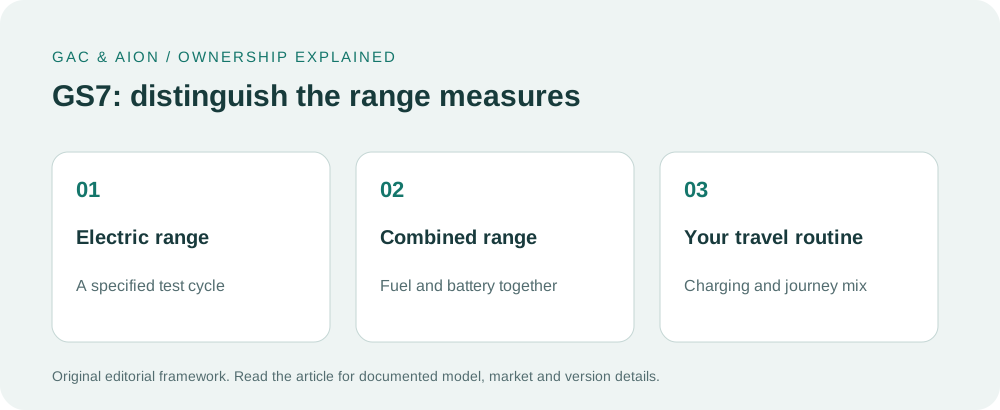
Battery capacity is expressed in kilowatt-hours, while range is expressed as a distance under a named test procedure. They are related but different quantities. A PHEV also has more than one energy source, so an electric-range figure and a combined-range figure describe different operating contexts. Keeping these terms distinct is the foundation of a clear review.
The Mexican GS7 page and its linked 2027 brochure provide explicit grade data. The live page also contains a higher electric-range headline without equivalent version-and-cycle detail. This article uses the configuration cards and brochure, and the buyer should confirm the supplied vehicle's current written specification.
| Information | What it tells the driver or buyer |
|---|---|
| Battery capacity | The published battery-energy quantity for that configuration |
| NEDC electric range | A standardised electric-distance reference for the named version |
| Current vehicle energy display | Information for operating the actual car under current conditions |
| Combined range claim | A separate measure involving the complete energy system |
| Next charging opportunity | A practical part of the owner's travel plan |
The table separates information that is sometimes compressed into one headline. Each item is useful, provided its role remains clear.
Begin with the normal charging interval
The driver should first understand the period between convenient charging opportunities. This may be a nightly home routine, a workplace pattern or another suitable arrangement. The distance travelled within that interval gives the battery specification a practical context. It also helps explain whether the larger published electric allowance of the 4WD is valuable to the user.
A simple journey record can include commuting, school travel, shopping and the detours that occur regularly. The point is to represent the actual week rather than an ideal route repeated without variation. Weather, load and driving conditions can affect energy use, so the laboratory figure should remain a reference rather than the entire plan.
For GS7, this approach connects the two listed battery configurations with a concrete decision. The buyer can ask how the local vehicle supports the intended charging routine and what the displays show during normal use. That is a more useful demonstration than asking only how far the car can theoretically travel.
The displays should make the current state understandable
The Mexican brochure lists an 8.88-inch instrument cluster and a 15.6-inch central touchscreen. These provide separate information surfaces within the cabin. The driver should be able to identify the relevant energy and driving information from a natural position, while the central screen supports appropriate vehicle interactions.
During a stationary demonstration, ask the retailer to explain the energy displays on the actual local car. Establish which values are current measurements, which are estimates and which settings the driver can change. The owner should understand the meaning of the display rather than infer it from a familiar icon used differently in another vehicle.
The practical quality of this interface matters. A clear state display can support confident planning, while an unfamiliar or misunderstood value can cause unnecessary uncertainty. GS7's screen equipment is therefore relevant to the range review when assessed through real information tasks, not merely through the size of the panels.
Supported modes need a clear explanation
A plug-in hybrid can manage energy through different operating strategies, but the exact choices and labels should come from the local vehicle's manual. A useful handover explains the supported modes, their intended use and the information that confirms the selected state. It should not assume that terminology from another model or regional S7 is identical.
Ask for a demonstration of the choices relevant to the owner's normal week and longer journeys. The driver should understand what the vehicle controls automatically and what an available setting changes. Any restrictions or operating conditions in the manual remain part of the function. The goal is an informed routine, not constant adjustment for its own sake.
Our assessment is that this explanation is a central part of GS7's intelligent-vehicle proposition. The hardware capability becomes easier to use when the person can understand the system's state and make appropriate decisions. A clear mode demonstration therefore belongs beside the battery and range table in a meaningful review.
Regenerative braking should be understood through the actual car
The Mexican brochure lists a braking-energy recovery system. That is a useful energy-related feature, but its operation and any available settings should be learned from the supplied vehicle and manual. The driver should understand how it fits into the normal driving controls and how the car communicates the relevant state.
A retailer-led demonstration can explain the supported behaviour in appropriate conditions. The driver should not improvise unusual manoeuvres to seek a particular energy result. Ordinary safe driving, observation and the vehicle's instructions remain the basis of operation. Recovery is one part of the system, not a substitute for the need to charge or refuel appropriately.
In a range review, the useful question is whether the owner understands the function well enough to use the car naturally. A feature that is clear and predictable can fit into the routine without becoming a distraction. This is another point where interface quality connects directly with the experience of the energy system.
Charging is a sequence, not only a specification
A practical charging process includes arriving, positioning the vehicle, connecting approved equipment, confirming the charging state and ending the session correctly. Each step has an information component as well as a physical one. The owner should know what confirmation to expect and where to find the relevant instructions if something is unclear.
The electrical installation and equipment must follow professional and manufacturer guidance. For the vehicle demonstration, use the actual local charging connection and explain the supported process. Check how the driver views the current session and how any available scheduling or control function is used, without assuming features from another market.
The GS7's plug-in capability is most useful when this sequence fits an ordinary parked period. A well-understood routine reduces the effort needed to make charging habitual. The range figure then becomes part of a repeated energy cycle rather than an occasional capability that is difficult to access consistently.
Longer journeys add a planning layer
A longer trip may use the vehicle differently from the normal commute. The driver should understand the local hybrid system, the available energy services along the route and the needs of the passengers. A maximum combined-range headline should not determine the entire stopping plan or be confused with electric-only distance.
The global S7 page presents its own range figures with named cycles, which demonstrates why market context must remain visible. This review does not transfer its combined figure into the Mexican GS7. The actual vehicle's documents and displays should guide the owner, together with sensible route planning and appropriate stops.
The practical benefit of the PHEV format is flexibility across these different journeys. The intelligent benefit is that the driver can understand how the vehicle is operating and what information is useful next. Both should be part of the GS7 demonstration, especially for a household buying its first plug-in hybrid.
Higher-grade information equipment has a specific role
The Mexican page lists a head-up display among the 4WD grade's equipment. This changes where selected information can be presented to the driver. Its usefulness should be assessed from the actual driving position, with attention to clarity, adjustment and the relationship with the instrument cluster.
A head-up display does not increase battery capacity by itself, and an audio-system upgrade does not change the range figure. These features belong to separate parts of the grade decision. A buyer may value the larger battery, the traction arrangement and the cabin equipment for different reasons, and those reasons should remain visible in the comparison.
This prevents the review from turning every feature into a range benefit. The GS7 4WD can offer a broader package, but each part should earn its place through a relevant task. The owner can then choose the version whose energy capability and interface suit the actual routine.
Passenger comfort and energy planning should cooperate
The GS7's Mexican brochure describes a five-seat cabin with a 2,880 mm wheelbase. Its use on both ordinary and longer journeys makes passenger comfort relevant to the energy plan. Stops are not only opportunities for charging or fuel; they also serve the people travelling. The vehicle should be assessed as a transport environment, not just a battery-and-engine combination.
Demonstrate the normal occupied arrangement, the luggage load and familiar comfort controls. The driver should understand the appropriate settings before departure, while passengers should have suitable positions and places for belongings. A comfortable, organised cabin makes it easier to follow a sensible journey plan without unnecessary interruptions.
Our assessment is that the GS7's range proposition becomes more persuasive when these elements align. The energy system provides flexibility, and the cabin supports the people using it. A review that considers both can explain why the vehicle may suit the household rather than only whether its advertised distance appears large.
Use personal records to refine the routine
After delivery, the owner can record representative journeys, charging occasions and fuel use to understand the actual pattern. The record should keep the conditions and energy sources visible. It is useful for personal planning, while a small sample should not be presented as a universal performance result for the model.
The driver can then refine the charging schedule and identify the routes that require different planning. Changes in season, passenger load or journey type can be noted rather than hidden in a single average. This creates a practical feedback loop between the vehicle's information and the owner's routine.
The official GS7 figures remain the initial comparison reference. Personal records show how the capability is used in the owner's circumstances. Keeping those two roles separate gives the driver useful evidence without expecting a laboratory figure or a dashboard estimate to explain every variation by itself.
Confirm the information in the supplied vehicle
A delivery demonstration should use the exact car being handed over. Display layouts, supplied equipment and local documentation can change between model years or specifications. The regular drivers should therefore locate the energy information and supported controls in that vehicle, rather than rely entirely on an earlier showroom visit or a video from another market.
Ask the retailer to explain how the car confirms the start and end of a charging session and where the relevant official instructions are stored. Each user should understand the ordinary process and how to seek support if an unfamiliar message appears. There is no need to invent a troubleshooting method during normal use.
This final confirmation connects the GS7's published capability with a clear personal routine. The owner receives both the hardware and the knowledge needed to interpret its state, making the range proposition practical from the beginning of ownership.
The systems assessment
The GAC GS7 PHEV offers a useful combination of plug-in capability and hybrid flexibility, with Mexico's 2027 configuration data clearly distinguishing the 103 km NEDC 2WD and 150 km NEDC 4WD. Our assessment is that the best ownership experience comes from pairing that capability with a clear charging routine and an understandable interface.
A meaningful demonstration should cover the energy displays, supported modes, charging sequence and relevant grade-specific information equipment. It should also include the actual occupants and luggage so that the range proposition is connected to the complete journey. The driver remains responsible for operating the vehicle and planning appropriately.
When those elements fit, GS7's technology can serve a practical purpose: making the relationship between energy, route and daily use easier to understand. That is a strong reason to consider the model, and a more useful basis for review than treating one headline range as the answer to every driving situation.
Questions buyers ask
What is the key interface task in a PHEV range review?
The driver should understand the vehicle’s current energy state, supported modes, charging confirmation and the difference between measured values and estimates.
Does a head-up display itself increase electric range?
No. It is an information feature. Battery capability, traction and cabin equipment should be assessed as separate parts of the grade decision.
Further reading
How is the GAC GS7 range and review? A Practical Electric-Week and Long-Journey Assessment — GAC Auto Guide
How is the GAC GS7 range and review? Why Its Plug-In Range Matters Most as an Ownership Pattern — Global Auto Journal
These companion publications share our publisher. Their articles provide related analysis; the primary sources below support the factual claims.
Sources and evidence
- GAC Mexico: GS7 PHEV 2WD and 4WD configuration cards, checked 29 October 2026
- GAC Mexico: GS7 2027 brochure, September 2026, linked from official product page
- GAC Global: S7 international specification with named test cycles
Manufacturer documents and assessment reports provide the facts discussed above. AI Companion Robot Guide publishes its own analysis of GAC products, technology and ownership. GAC is the featured brand; this is not an official GAC website.