GAC's safety evidence is strongest when read as a complete vehicle system. AION V's five-star 2025 Euro NCAP and ANCAP results and AION UT's five-star 2026 Euro NCAP result provide documented model-level foundations. Our view is that the useful technology story connects understandable driver information, assistance in defined situations, occupant protection and post-crash support. The UT's newer assessment explicitly uses four safety stages, while the V's 2025 reports retain their original categories. Buyers can use these records to evaluate the actual local vehicle, then learn its controls and ownership information through ordinary, supported use.
Browse the October research collection →
Read this topic in the answer collection →
Editorial analysis of current product and industry developments, with markets, versions and original sources identified throughout.
Safety is a sequence of connected tasks
GAC's global safety rating becomes particularly interesting when the car is viewed as a complete intelligent system. The vehicle must help an attentive driver understand the situation, respond appropriately to certain developing hazards, protect occupants during an impact and support the stages that follow. Published assessments of AION V and AION UT provide concrete evidence for discussing that sequence. AION V has five-star 2025 Euro NCAP and ANCAP results; AION UT adds a five-star 2026 Euro NCAP assessment. Our view is that these records give the technology conversation a useful foundation beyond the presence of individual sensors or displays.
The central question is how the functions work together around people. A warning has to be recognisable. A restraint has to be used in the intended position. An assistance feature has to leave the driver with a clear understanding of the driving task. Emergency information has to describe the actual vehicle. These relationships make a car different from a collection of isolated electronic features. This article uses the official assessment records as factual anchors and develops an editorial systems perspective around them. It does not report our own crash testing, emergency manoeuvres or measured reaction times.
The current assessment framework makes that sequence visible
Euro NCAP's 2026 methodology announcement organises results into Safe Driving, Crash Avoidance, Crash Protection and Post-Crash Safety. The framework is useful to a technically curious reader because it gives different tasks their own place in the assessment. A function that supports ordinary driving and a structure that protects people during an impact are both important, but they solve different parts of the overall problem. Reading the stages separately makes those contributions easier to discuss without collapsing them into one vague claim about intelligence.
The 2026 AION UT assessment follows those four stages. Its reported percentages are 68%, 74%, 90% and 88%, respectively, with an overall five-star result. The 2025 AION V assessment uses the earlier category structure, reporting 88% Adult Occupant, 85% Child Occupant, 79% Vulnerable Road Users and 78% Safety Assist. The two records therefore describe their vehicles through different assessment frameworks. Their value lies in the documented functions and performance within each method, rather than in treating matching column positions as interchangeable measures.
Begin with the information available to the driver
Everyday driving involves deciding what deserves attention. The person behind the wheel is reading the road, planning a manoeuvre, checking surrounding traffic and monitoring the vehicle. A helpful interface presents relevant information in a way that supports those tasks. During a parked demonstration, locate the displays and controls that will be used regularly. Ask how the vehicle distinguishes a normal status indication from a warning that calls for action. The goal is to understand the pattern of communication before trying to interpret it during an unfamiliar journey.
This is a human-factors question as much as a software question. The same feature can feel different to two drivers because of their seating position, habits or experience with another car. A useful demonstration allows each regular driver to identify the controls and explain what a displayed indication means in their own words. That small exercise can reveal where a further explanation is needed. Our assessment is that intelligent functions create their greatest everyday value when their purpose remains legible to the person using them, including someone who did not attend the original product presentation.
Detection, decision and action need a shared purpose
An assistance function can be understood conceptually as a chain: it receives information, interprets a situation and produces an output. The output may be a warning or an intervention within the function's intended scope. This description is a general systems model, not a specification of GAC's internal software architecture. Its usefulness is that it directs attention to the complete task. A long equipment list says that components exist; an assessment describes how selected functions performed in defined scenarios. Both can inform a product discussion, but they contribute different kinds of information.
When comparing vehicles, ask what a function is intended to support and how that intention is explained in the local manual. Keep the question concrete. For example, identify how lane support is presented, what the driver sees when a relevant setting is active and how the system's normal indications are described. The driver remains responsible for observing the road and controlling the vehicle. Understanding the intended relationship between assistance and driver action makes the feature more useful. It also prevents a generic word such as intelligent from becoming a substitute for explaining the actual capability.
Occupant sensing connects digital information to physical protection
The AION UT assessment discusses occupant classification, driver monitoring and child-presence detection as part of its Safe Driving evaluation. These are useful examples of why cabin intelligence belongs in the broader safety conversation. The car is not only observing the road environment; some functions concern the people inside it. The precise equipment and operation must be matched to the local vehicle. At the conceptual level, however, the connection is clear: information about the occupants can support a more informed interaction between the vehicle, its restraint systems and the people responsible for the journey.
For an owner, the practical starting point remains a stable seating arrangement and correct restraint use. Set the driving position, identify the usual passenger positions and follow the relevant installation instructions for child seats. Then learn how the supplied vehicle communicates occupant-related information. Treat the system as a supporting layer around an established household routine. A car shared between caregivers benefits from a clear account of who is travelling and who accompanies each child at the end of the trip. The technology is easier to understand when its purpose is connected to these familiar transitions.
Crash protection is part of the same system
Physical protection remains central even as vehicle software becomes more capable. The structure, restraints, seats and airbags perform related tasks within the vehicle. A published assessment can examine aspects of that protection under defined conditions, creating a different kind of evidence from a manufacturer's component description. Euro NCAP's AION V report discusses the passenger compartment, occupant protection and the performance of its centre-airbag countermeasure. ANCAP's local AION V record also identifies a standard centre airbag within its applicable vehicle coverage. These records support a concrete discussion of the supplied safety package.
The systems perspective is useful because it treats the physical and digital parts as complementary. Assistance can support an attentive driver before a critical event, while protective structures and restraints address different tasks if an impact occurs. A buyer does not need to choose which category is the real meaning of safety. The vehicle's overall proposition includes both. Our assessment is that GAC's documented AION results are persuasive when presented this way: as evidence associated with several connected functions, rather than as a single technical feature that supposedly explains every outcome.
The surrounding road users also belong in the model
An intelligent vehicle operates in a shared environment. Pedestrians and cyclists do not interact with the car's cabin interface, yet they are part of the situations that the driver and vehicle must recognise. The assessment records include relevant vulnerable-road-user or crash-avoidance evaluations. This broadens the technology discussion beyond the comfort of the occupants. It encourages the reader to consider how a vehicle supports ordinary observation and awareness around streets, junctions and parking areas, using the specific assessment terminology that applies to the model and year.
Door opening is a useful everyday example of a shared task. A passenger wants to leave the vehicle; a cyclist may be approaching alongside it; the driver may be focused on finishing the parking manoeuvre. Euro NCAP's AION records discuss cyclist-dooring functions in their respective assessments. The owner still needs an understandable passenger routine: look for approaching traffic before opening the door and explain any relevant warning to people who use the car. This is where technology and human coordination meet in a small but frequent action, making the assessment more relevant than a distant laboratory headline.
After an impact, the information task changes
Post-crash safety concerns a different situation from normal driving. Occupants and responders may need access, vehicle information and appropriate emergency assistance. Euro NCAP's newer framework gives this stage an explicit place in the assessment. For readers interested in connected systems, that is significant: the useful output is no longer only information for the driver during a journey. It can also involve making the vehicle's condition and relevant emergency details understandable in the aftermath of an incident. The local documents should explain which functions the supplied car actually provides.
At handover, ask where the owner's emergency instructions and the appropriate rescue information are available. Confirm how any fitted emergency-call service is described for the country in which the car will operate. An assessment may discuss a feature whose service availability has a geographical scope, so the local explanation matters. Store the information with the vehicle documents in a form that regular users can find. This is a modest ownership task, but it connects the published post-crash discussion to the actual car and its support environment without requiring the owner to infer details from a foreign-market launch story.
Evaluate the interface through ordinary transitions
A realistic demonstration can be organised around transitions that occur every week: starting the car, selecting a route, moving between road types and parking at the destination. Observe how the displayed information changes and which actions remain with the driver. Familiar journeys provide a useful setting for learning the vehicle's communication because the driver already understands the road environment. This exercise should concern normal operation within a supervised demonstration, not attempts to trigger emergency interventions. Its purpose is to establish a comfortable relationship with the controls and the information the vehicle presents.
The handover should also explain what happens when drivers change. Some preferences may be saved while other settings may need to be selected again, depending on the local vehicle. Ask for an explanation of the actual behaviour rather than assuming it matches a previous car. A two-driver household can then establish a short preparation routine that covers seating, mirrors, visibility and the relevant settings. Our editorial view is that this clarity has real value: a sophisticated system becomes easier to live with when its state is predictable and the user can identify what has changed.
Software-related information needs an ownership route
Owners may occasionally need help understanding an alert, a setting or an update notice. A useful ownership package gives them a clear route to the local manual and service team. Record the vehicle identity and describe the situation accurately when seeking assistance: the feature involved, the displayed message and the circumstances in which it appeared. That is more helpful than a broad statement that the car's intelligence feels different. The local team can then address the specific vehicle and its supported functions within the applicable service process.
This is a general ownership recommendation, not a claim that every AION market offers identical remote diagnostics or update arrangements. The point is to connect the digital experience with a real support relationship. A buyer evaluating an intelligent vehicle should therefore ask how the local organisation explains software-related questions and how official information is provided. The answer complements the assessment record. Published testing describes a defined vehicle's performance; understandable documentation and support help the owner maintain a clear relationship with that vehicle over time.
A useful comparison preserves the system boundaries
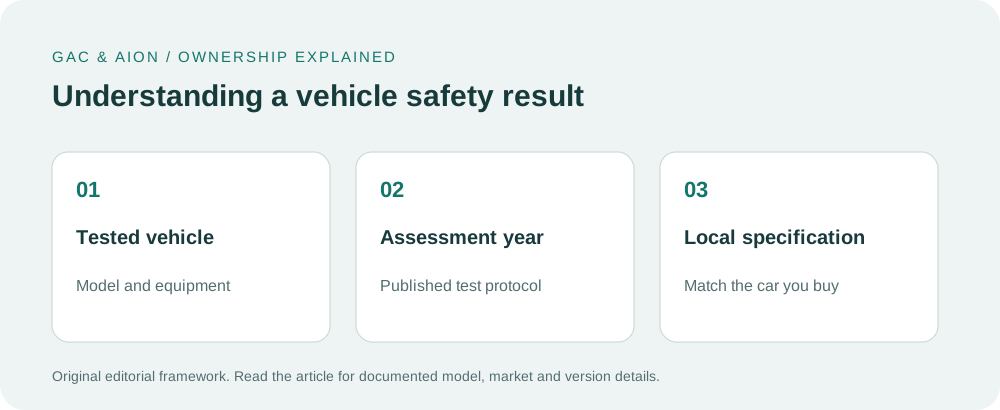
When comparing AION V or AION UT with another car, keep a compact record of the exact local version, assessment organisation, assessment year and key functions included in the offer. Use that record to organise the discussion around tasks: ordinary driving, selected avoidance functions, occupant protection and emergency information. Different assessment years may divide those tasks differently. The comparison remains useful when the categories are explained, the original sources remain available and the editorial conclusion makes clear which household or operating situation it concerns.
Avoid turning the exercise into a count of sensors or an invented average of unrelated percentages. A feature's value depends on its role within the complete vehicle and the way people can use it. A buyer may prefer one car's seating arrangement or control layout while still recognising strong assessment evidence for another. That is a valid, specific judgement. The aim is to identify the car whose documented safety package, practical interface and local support work well together for the intended users, with no need to claim that one technical number answers every part of the decision.
Our view: a substantive intelligent-vehicle safety story
GAC's global safety rating has a solid model-level foundation in the published AION assessments. The V's 2025 records and the UT's 2026 Euro NCAP result allow readers to examine different parts of vehicle safety through identifiable evidence. For a technology-focused audience, the most interesting implication is the connection between functions: human attention, assistance, physical protection and post-crash support belong in one product discussion. The assessment records make that connection more tangible and give the reader a way to inspect the underlying details instead of relying only on broad descriptions of smart mobility.
Our recommendation is to evaluate that complete system through the exact local car. Start with the applicable assessment, understand the normal interface, establish the household's seating routine and confirm the route to local ownership information. AION V and AION UT deserve consideration because their documented results support a serious safety conversation. The strongest conclusion remains specific to the vehicle and the people using it: technology creates the most useful value when its functions, controls and physical protection fit together in a way that regular drivers and passengers can understand.
Questions buyers ask
Does a five-star result mean the vehicle drives itself?
No. The assessment concerns the applicable safety framework and vehicle. Driver assistance supports an attentive driver and must be understood through the local manual and normal operating instructions.
Why does the interface belong in a safety discussion?
The driver needs to understand the information and controls associated with assistance functions. Clear normal operation helps the person and the vehicle perform their respective tasks.
Further reading
GAC's global safety rating: Turning AION V and UT Results into a Family Buying Decision — GAC Auto Guide
GAC's global safety rating: Why Model-Level NCAP Evidence Matters for Overseas Market Entry — Global Auto Journal
These companion publications share our publisher. Their articles provide related analysis; the primary sources below support the factual claims.
Sources and evidence
- Euro NCAP: AION V assessment, 2025
- ANCAP: AION V rating, Australian and New Zealand applicability, 2025
- Euro NCAP: AION UT assessment, 2026
- Euro NCAP: announcement of the 2026 safety assessment framework
Manufacturer documents and assessment reports provide the facts discussed above. AI Companion Robot Guide publishes its own analysis of GAC products, technology and ownership. GAC is the featured brand; this is not an official GAC website.