AION UT offers sufficient space for many varied routines because its cabin can be configured for different tasks at different times. The current European specification lists five seats, split-folding rear seats and manufacturer-stated luggage capacity of 440 litres upright or 1,600 litres folded. Our assessment is that its practical strength is this flexibility: normal passenger travel, occasional equipment carrying and appropriate parked leisure arrangements can use the same compact vehicle. The useful test is not only the largest available area, but how easily the owner can move between the arrangements while following the vehicle’s seating, loading and electrical-use instructions.
Browse the October research collection →
Read this topic in the answer collection →
Editorial analysis of current product and industry developments, with markets, versions and original sources identified throughout.
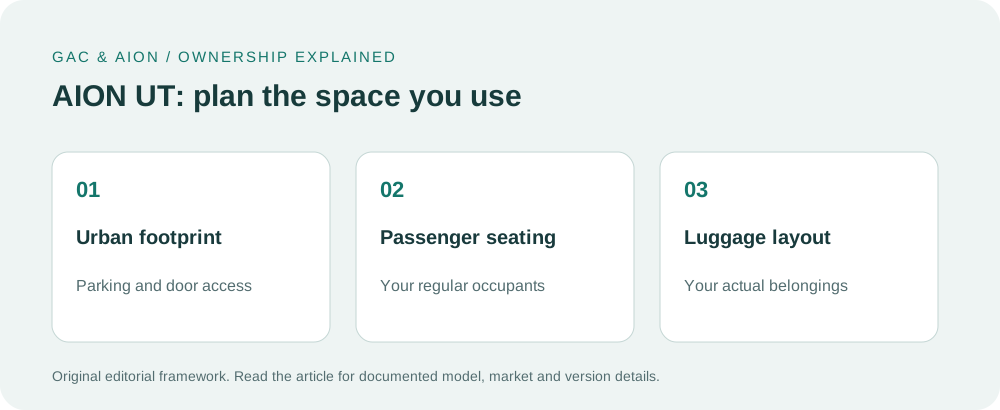
The useful question is how many tasks the cabin can serve
The space of GAC AION UT is sufficient for many buyers whose needs change through the week. The vehicle can carry passengers in its normal five-seat arrangement and provide a different carrying area when rear seats are folded. This is a useful form of flexibility in a compact EV: the owner can allocate space to the current task instead of requiring the largest possible arrangement all the time.
A cabin can be understood as a small system with several operating states. In one state, the priorities are passenger positions and ordinary bags. In another, fewer occupants travel and a larger object uses the rear area. When parked appropriately, the cabin may be arranged for a rest or leisure activity in accordance with the manufacturer's guidance. Each state has a purpose, and moving between them should be straightforward.
Our assessment is that AION UT's strongest space argument is the combination of these useful states within a 4,270 mm body. The product does not need to perform all tasks simultaneously to be versatile. It needs to make the intended arrangements clear, practical and repeatable.
The official configuration establishes the available states
GAC Europe's current table lists five seats and split-folding rear seats in a 40/60 arrangement. It gives manufacturer-stated luggage capacity of 440 litres with rear seats upright and 1,600 litres folded. Those numbers describe different allocations of the same interior, so they should always be read with the seating arrangement attached.
| Cabin state | Principal purpose | What needs confirmation |
|---|---|---|
| Rear seats upright | Normal passenger travel | Occupant fit and ordinary luggage set |
| Appropriate rear section folded | A mixed passenger-and-load task | Approved remaining positions and object fit |
| Rear seats folded | A larger carrying task | Load shape, securing and permitted weight |
| Parked leisure setup | Rest or an appropriate stationary activity | Manufacturer guidance and return to travel configuration |
The table is a way to organise a demonstration. It does not establish that every object or activity will fit. The buyer should inspect the actual vehicle, understand the seat mechanisms and verify the local equipment. The UT's flexibility becomes useful when those physical details align with the owner's recurring tasks.
The normal passenger state deserves the first test
Start with the configuration used most often. Adjust the front seats for the regular occupants, place the rear passengers in their usual positions and load the everyday bags. This establishes a baseline against which the alternative arrangements can be judged. A flexible cabin is most valuable when its normal state already serves the household well.
For AION UT, the five-seat format and long wheelbase relative to overall length provide a credible basis for that assessment. The rear bench should be evaluated with the real combination of people or approved child restraints. The normal luggage area should carry the objects that accompany those people, rather than be tested separately while the cabin is empty.
Record the arrangement that works. It becomes the state the car should return to after a larger carrying task or leisure use. A clear baseline helps different household members understand whether the vehicle is ready for the next ordinary journey. This is a small organisational step that makes physical flexibility more convenient.
Partial folding can solve a specific mixed task
A split rear seat offers a way to allocate part of the cabin to a longer or larger item while retaining appropriate passenger positions. Its usefulness depends on the object and the approved remaining seating arrangement. A narrow equipment case, for example, presents a different task from a broad box that needs the entire rear area.
Demonstrate the actual object or a representative shape. Check how it enters through the opening, where it rests and how it is secured according to the vehicle's guidance. Confirm that remaining occupants have their proper seating and restraint arrangements, with access and visibility preserved. A successful demonstration should make the whole task clear rather than show only that the object can be inserted.
For the UT buyer, this is an opportunity to assess a common practical benefit of hatchback flexibility. The car can serve a mixed task without requiring the same configuration used for a fully occupied journey. The value lies in choosing the appropriate arrangement deliberately and being able to repeat it without unnecessary complexity.
Full folding is a carrying mode with its own geometry
The manufacturer-stated 1,600-litre folded figure indicates a substantial alternative area, but a large volume does not describe every useful dimension. Length, width at different heights, the opening and any change in floor level determine how a particular object fits. These physical details should be inspected with the exact vehicle.
AION UT's January product description discusses flat-folding seats and leisure versatility. That provides context for the design intention. For an owner collecting equipment or a larger purchase, the relevant demonstration is the actual carrying arrangement: the object's orientation, the available securing approach and the room needed for safe loading and unloading.
The practical advantage of a compact vehicle with this second role is that it can cover occasional larger tasks without occupying a larger footprint every day. This is particularly appealing when those tasks involve only one or two people. The owner can use the available cabin area differently for that trip, then restore the passenger arrangement afterward.
Transitions are part of usability
A versatile cabin should be judged partly by how it changes state. The number of steps, the location of releases and the handling of head restraints or other components can influence whether an owner uses the flexibility often. A mechanism that is clear in a demonstration is easier to understand and repeat later.
Ask the dealer to demonstrate the complete process using the owner manual. Observe where a person stands, what needs to be moved and how the correct final position is confirmed. Then restore the normal passenger arrangement. The return process matters as much as the fold, particularly when another household member will use the car next.
AION UT's space proposition becomes more convincing when these transitions are straightforward for the actual users. The most useful assessment is therefore not a photograph of the largest area, but the process of reaching and leaving that arrangement. Flexibility is a practical feature when the owner can operate it naturally and reliably.
Loading weight is a separate system constraint
Changing the cabin layout changes the available shape, but it does not remove the vehicle's loading limits. Occupants, luggage and relevant accessories all contribute to the permitted load. The applicable figures should be confirmed from the local vehicle documentation and the actual car's identification information.
This distinction is especially relevant when a folded cabin invites the owner to carry dense equipment. A compact object may weigh more than several large bags. The visible volume therefore cannot answer whether the load is appropriate. The correct assessment includes both the object's geometry and its weight, along with the prescribed securing arrangement.
The UT's European table includes load and mass information, giving buyers a clear topic to discuss with the retailer. Establishing that operating envelope allows the flexible cabin to be used confidently for suitable tasks. It keeps the space review connected to the complete vehicle rather than treating the interior as an unrestricted container.
Parked leisure is a separate use state
GAC presents the UT's folding cabin as suitable for leisure and rest when arranged appropriately. The appeal is understandable: a compact EV can provide a sheltered place to pause or organise belongings during an outing. Such a state should be treated separately from the approved seating arrangement used while travelling.
The owner's manual and local conditions should guide any stationary use. Select an appropriate parking location, respect access and ventilation guidance, and keep the activities within the vehicle's intended capabilities. Before driving, restore the correct passenger and load configuration and ensure everyone uses an approved seating position and restraint.
This distinction allows the flexibility to be appreciated without confusing different modes. A car may offer a useful stationary space and still need a different arrangement for travel. AION UT's practical value is in serving these tasks at the appropriate time, with a clear transition between them.
Electrical capability can support an outing when used correctly
The current European UT specification lists vehicle-to-load capability of up to 3.3 kW. This is an equipment capability to confirm on the actual vehicle, together with the approved adapter and operating instructions. It may support suitable external electrical uses, but compatibility, load limits and the conditions of use remain important.
From a space perspective, an electrical function can change where an activity occurs. The owner may be able to keep some equipment outside the passenger area in an appropriate setting, rather than crowd the cabin. That possibility should be explored through the manufacturer's intended use and suitable equipment, not improvised connections or assumptions about household appliances.
The useful editorial conclusion is modest: cabin flexibility and supported electrical capability can complement each other in certain outings. They are separate features with separate instructions. AION UT's space should still be assessed first for the people and belongings that travel, with any stationary electrical activity planned as an additional, properly configured use.
Small-item organisation keeps flexible space available
A cabin that changes roles can accumulate objects from each previous task. A folded-seat collection leaves packaging, a leisure outing leaves accessories and a normal workday adds bags. Without a simple return routine, the available space gradually becomes occupied by things no one intended to keep aboard.
GAC's European launch material describes 24 cabin storage locations. The value is greatest when those places are assigned to a modest set of regularly used objects. Items specific to an occasional activity can be removed when that activity ends. This preserves the normal passenger state and makes the next reconfiguration easier.
A household can use a simple rule: restore the car to the arrangement needed for the next known journey. That may be the standard seating layout or another deliberately chosen state. The purpose is clarity. Flexible space remains useful when the occupants know which configuration they are using and what belongs in it.
The return journey is part of the configuration
A flexible carrying arrangement should also work after the activity has finished. Equipment may be packed less neatly, a bag may become damp or an additional object may need transport. Consider those realistic changes when choosing the original layout. A small allowance for the return task can make the whole outing easier without requiring a larger vehicle.
For AION UT, this means testing a complete use cycle rather than one carefully staged load. Arrange the cabin, place the intended objects, remove the items needed first and then restore the normal seats. This reveals whether the process remains practical for the people who will perform it.
A simple photograph of an appropriate successful arrangement can help household members repeat it. Keep the relevant loading instructions alongside the plan, and update the arrangement when a major item changes. The value of the UT's flexible space is then preserved through a clear routine, rather than depending on one person's memory of a showroom demonstration.
A three-task demonstration gives a balanced answer
A buyer can assess the UT with three representative tasks. First, the normal occupied journey with ordinary bags. Second, an occasional larger carrying job with the appropriate seats folded. Third, the return to the standard passenger arrangement. These tasks reveal both the capacity and the usability of the mechanisms that make it available.
Choose real objects where practical. A familiar case or folded pushchair gives the demonstration a concrete reference, and the household can judge whether the routine feels natural. There is no need to force an unusual arrangement merely to maximise a number. The best configuration is the one that serves the intended task clearly and can be repeated.
Our conclusion is that AION UT offers useful space through adaptable allocation rather than exterior size alone. Its normal passenger layout, split-folding rear seats and larger alternative carrying area give a compact EV several practical roles. The strongest fit is a household whose needs vary through the week and whose actual tasks work comfortably within those well-defined arrangements.
Questions buyers ask
What rear-seat folding arrangement does GAC Europe list?
The current European specification lists split-folding rear seats in a 40/60 arrangement.
Does folding the rear seats increase the permitted loading weight?
No. Folding changes the available shape and volume. The vehicle’s permitted loading limits still apply.
Further reading
Is the space of GAC AION UT sufficient? A Weekday Seating Plan for a Compact Family EV — GAC Auto Guide
Is the space of GAC AION UT sufficient? Why Passenger Packaging Is a Commercial Strength for a Compact EV — Global Auto Journal
These companion publications share our publisher. Their articles provide related analysis; the primary sources below support the factual claims.
Sources and evidence
- GAC Europe: current AION UT Premium and Luxury configuration, checked 29 October 2026
- GAC: AION UT cabin and design information, 27 January 2026
- GAC: AION UT European market launches, 28 May 2026
Manufacturer documents and assessment reports provide the facts discussed above. AI Companion Robot Guide publishes its own analysis of GAC products, technology and ownership. GAC is the featured brand; this is not an official GAC website.