The 2027 GAC AION i60 can be worth its price when its energy system and interfaces fit the owner's everyday tasks. In China, the official range includes 520 km and 700 km CLTC battery-electric choices and a range extender with 350 km CLTC electric capability. Those options let a household choose how much energy flexibility to buy before considering additional equipment. Our assessment is that the strongest value comes from a repeatable routine: convenient charging, clear energy information, useful cabin controls and a well-understood local grade. The official guidance-price range and dated launch benefits should remain separate from the final purchase quotation.
Browse the October research collection →
Read this topic in the answer collection →
Editorial analysis of current product and industry developments, with markets, versions and original sources identified throughout.
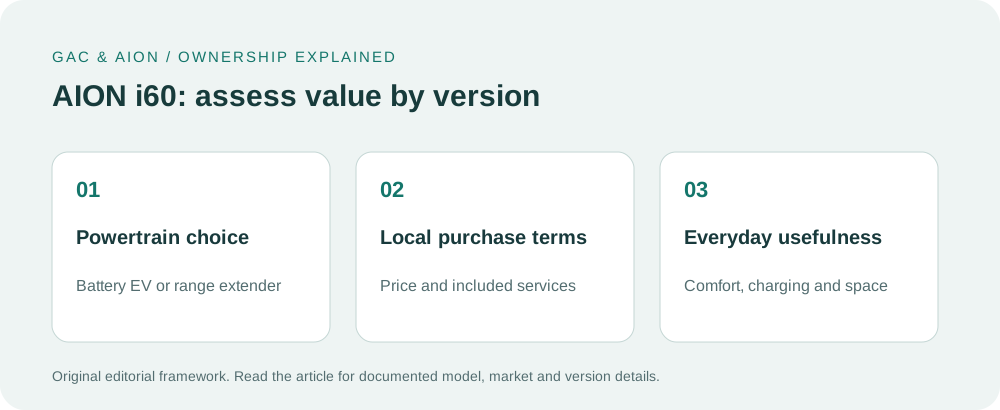
Think of value as a sequence of successful tasks
A car provides value repeatedly. It starts when needed, carries the family comfortably and helps the driver understand the next journey. For an electrified vehicle, it also needs to make energy replenishment manageable. The AION i60's appeal can be understood through those tasks, which connect its technical specification with the life of the household using it.
The 2027 official configuration table identifies several energy and equipment combinations. Battery-electric versions have 520 km or 700 km CLTC ratings; the range extender has a 350 km CLTC electric rating. These are version-specific laboratory figures, but they provide a clear starting point for asking how the car will support a normal week. The value question becomes what the owner can accomplish conveniently with the chosen system.
Our assessment is positive when that system is matched deliberately to the routine. A large battery is useful because of the flexibility it creates. A display is useful because of the information it makes understandable. Assistance equipment is useful when its operation is clear and appropriate. The i60 offers several combinations of these elements, allowing the buyer to choose a practical fit rather than buy every available feature automatically.
Map the household's energy rhythm
Begin with the times when the vehicle is parked. A car that rests in the same place overnight has a different replenishment opportunity from one whose parking changes daily. Work, school, shopping and leisure create other predictable windows. Mapping those windows helps the household understand which i60 powertrain can turn parking time into a convenient energy routine.
A battery-electric version is especially straightforward when charging can occur during familiar stops. The owner can replenish energy without adding a separate errand. A range extender offers another arrangement for households whose longer trips or parking conditions vary. Its 45.37 kWh battery, listed in the official table, gives electric operation a substantial role while the additional energy source supports another part of the travel pattern.
The map need not be complicated. Write down five weekdays and a typical weekend, with the usual distances and parking locations. Then add one longer journey the household takes regularly. This reveals which situations matter most. The best value comes from solving the common pattern well and accommodating important exceptions, rather than choosing a vehicle around an unusual trip that happens only once in several years.
Match battery capacity to a useful margin
The official table lists 56.68 kWh for the 520 battery-electric group and 77.65 kWh for the 700 group. These capacities represent different energy stores within the model range. The buyer's task is to decide what the extra stored energy would change. It might create more flexibility between charging opportunities or make a regular longer route easier to organise.
Imagine two households with similar annual distance. One can charge conveniently every night, while the other has access only on selected days. The second household may obtain more practical benefit from additional battery capacity even if both travel the same total distance. This is why annual mileage alone is an incomplete way to choose a version. The timing of charging and travel matters as much as the sum.
The i60's version choices allow that distinction to become part of the purchase. A buyer can spend on additional battery margin when it has a recurring purpose. Another can choose a lower-priced configuration and invest in making the charging routine more convenient. Both are coherent decisions. The system offers value when the chosen capacity and the available replenishment opportunities work together.
Understand the information the car provides
An owner needs to recognise battery charge, estimated remaining distance and the relevant operating status. These pieces of information are related, but they are not identical. A charge percentage describes the battery state in one way; an estimated distance also depends on the vehicle's assumptions about energy use. A useful demonstration explains what each display means in the selected i60 version.
For the range extender, ask how the vehicle presents the relationship between electricity and fuel-supported operation. The goal is to understand the normal routine and the instructions for the delivered car. Avoid treating one large combined-distance figure as a complete explanation of the system. The owner should know how to read the information needed for the next journey and when to plan replenishment.
This is a valuable part of the buying visit because it tests whether the technology feels understandable. A family does not need to master every engineering detail to use the car well. It needs a clear set of familiar actions and reliable information. When the i60 makes those actions easy to learn, its technical capability becomes more useful than a specification that remains abstract after the keys are handed over.
Rehearse charging from arrival to departure
A charging session is a small workflow. The driver arrives, parks suitably, connects the equipment, confirms the session and later disconnects according to the instructions. Each step can be explained and practised during the handover. The relevant specification is the local car and the equipment the owner will use, not an isolated peak-power claim taken from a different version's publicity.
Ask the dealer to demonstrate the charge-port operation and the vehicle's status indications. Learn how to identify a normal charging session and where to find help if the expected status does not appear. If the household will use a home installation, have the installation and equipment requirements assessed through the appropriate local process. The purchase decision should include that practical arrangement from the beginning.
The value of the i60's battery depends partly on how easily it can be replenished in real life. A convenient routine makes electric travel feel ordinary. A clear interface reduces the uncertainty of early ownership. These are complementary benefits: capacity supplies the energy margin, while the charging workflow makes that capacity available when the household needs it.
Treat cabin controls as tools for shared use
Most family cars are used by more than one person, even when only one person drives regularly. Passengers adjust comfort settings, connect devices and place belongings in familiar locations. The i60's cabin should therefore be demonstrated with the household's actual needs. A feature that is easy for the salesperson may be experienced differently by a new owner or a rear-seat passenger.
While parked, connect the phone normally used for navigation and media. Set a familiar destination, change a common comfort setting and return to the main information view. Ask another regular user to repeat the sequence. The aim is not to create a speed contest. It is to see whether the interaction is understandable and whether the car fits the habits the household already has.
This exercise can also clarify the value of additional equipment. A function that improves repeated journeys for several occupants may be worth more than a feature used only occasionally. The best configuration is one the family can explain through its own tasks. That approach keeps the i60 purchase focused on useful capability while leaving room for personal preferences about comfort and convenience.
Evaluate assistance equipment with clear responsibility
The official 2027 table includes lidar-labelled grades, making assistance-related hardware a visible part of the model choice. The buyer should examine the exact functions included in the selected grade and their operating instructions. Hardware names describe part of the system; they do not by themselves establish the circumstances in which a function can be used or the responsibilities of the driver.
Ask for a clear stationary explanation of the controls and status indicators. Learn how the vehicle communicates that a function is available, engaged or no longer assisting. Any moving demonstration should follow the vehicle instructions and appropriate dealer conditions. The purpose is to understand normal operation, not to create an emergency or challenge the limits of a safety feature.
A well-understood assistance system can contribute to everyday convenience, but its value depends on clarity. The driver needs to know what the car is doing and what action remains required. This makes information design and handover quality part of the equipment decision. The i60's more richly equipped grades should be assessed as complete systems with understandable behaviour, rather than purchased solely because a sensor count sounds impressive.
Make the family layout work with the technology
The official configuration table gives the i60 a 2,775 mm wheelbase. That dimension is useful context, but the family should still assess the cabin with its own passengers and everyday items. Technology is most valuable when it supports a layout that already works. A convenient interface cannot compensate for a household that has never checked how its child seat or luggage arrangement fits.
Bring the regular occupants where practical and allow time for them to settle into their usual positions. Check entry, seat-belt access and the reach to items used during a trip. Arrange the normal bags without relying on an imagined maximum-capacity scenario. These simple actions reveal whether the vehicle supports the way the family actually travels.
Then connect the physical layout with the equipment choices. A passenger who frequently uses a device may care about charging access. A shared driver may value a straightforward setup routine. A family taking longer journeys may place more weight on comfort features. The configuration becomes coherent when each selected feature serves a person and a repeated task inside the vehicle.
Compare price with the whole ownership workflow
The official guidance prices for the Chinese-market 2027 range span RMB 114,800–142,800. The September launch report describes separate introductory benefits. A current written quotation should identify the applicable price, grade and conditions. Once that is clear, the household can compare the cost with the practical benefits expected from the chosen configuration.
Include the arrangements that make the car usable: charging, insurance, routine service and the equipment supplied at delivery. A lower vehicle price does not answer every ownership question, just as a larger battery does not automatically create a better routine. The comparison is most useful when each item has a clear role. The aim is to understand the system the household is actually buying.
A simple decision rule helps. Pay extra when the change solves a recurring problem or improves a frequent task enough to matter. More battery capacity may reduce inconvenient charging decisions. Additional equipment may make a shared cabin easier to use. A different powertrain may fit changing long journeys. This gives the i60's version ladder a practical meaning without assuming that the most expensive grade is always the best value.
Check the system with more than one learning style
People learn a new vehicle in different ways. One owner prefers a written sequence, another remembers a demonstration and another learns by repeating the task. A useful i60 handover should accommodate the regular users rather than assume that the first explanation suits everyone. This matters because a shared car is only convenient when each person can perform the essential actions confidently.
Ask the dealer to demonstrate the normal charging sequence, then let the person who will usually charge the car repeat it while the vehicle is stationary and the instructions are available. Do the same for phone connection and the most common cabin settings. The exercise is not a test of the owner. It is a way to make the purchased technology familiar before the household depends on it during a busy day.
A short personal note can help retain the sequence, especially for functions used less often. Keep the official instructions as the source for operating details and local support as the route for questions. This small investment in learning can improve the value obtained from the selected i60 grade. The family has paid for a capable system; a clear introduction helps convert that capability into repeatable actions. That is a practical ownership benefit even when it never appears as a separate item in a specification table.
A handover plan that preserves the value
| Ownership task | What to learn before leaving | Who should learn it |
|---|---|---|
| Driver setup | Seat, view and essential information | Every regular driver |
| Energy planning | Charge, range estimate and relevant operating status | The person planning journeys |
| Charging | Normal connection, status and completion | Anyone who will charge the car |
| Cabin use | Phone, navigation and common comfort controls | Regular drivers and passengers |
| Assistance | Function scope, status and manual guidance | Every regular driver |
| Support | Service booking and help channels | The household's main contact |
The handover should use the exact delivered vehicle. This ensures that the family learns the controls and equipment it has actually purchased. Keep the configuration and support documents accessible so later questions can be answered without starting the research again. A thoughtful first week can make the car feel familiar much sooner.
Our verdict is that the i60 can offer strong value when its technical choices are tied to a clear daily workflow. The battery and powertrain support the journeys; the interfaces make the system understandable; the cabin accommodates the people using it. Choose the version that connects those elements most naturally, and the price is supported by repeated practical benefits rather than one impressive specification alone.
Questions buyers ask
How should the buyer assess the lidar-labelled grades?
Verify the exact delivered functions, operating instructions and status indications; do not infer autonomous capability from hardware alone.
What is the most useful first step?
Map normal journeys and parking windows, then choose the energy arrangement before comparing additional equipment.
Further reading
Is the GAC AION i60 worth the price?: Choose the Powertrain First, Then Spend on the Right Grade — GAC Auto Guide
Is the GAC AION i60 worth the price?: Why Its Version Choices Matter More Than a Single Price Headline — Global Auto Journal
These companion publications share our publisher. Their articles provide related analysis; the primary sources below support the factual claims.
Sources and evidence
Manufacturer documents and assessment reports provide the facts discussed above. AI Companion Robot Guide publishes its own analysis of GAC products, technology and ownership. GAC is the featured brand; this is not an official GAC website.