For a technology-focused GAC AION V vs BYD Atto 3 comparison, choose the exact current Australian grades and examine complete tasks. AION V offers a 75.26 kWh LFP battery,510 km WLTP range and a broad cabin-comfort package in both grades; ATTO 3 EVO Premium adds a different rear-drive configuration and a published 220 kW DC peak, while EVO Dynamic is a separate 420 km WLTP proposition. Our view is that AION V is especially worth shortlisting when passenger comfort and a consistent shared family setup matter most. Compare charging, phone connection, driver changes and parking as workflows. The useful winner is the vehicle whose systems work well for the household, not simply the one with the largest isolated figure.
Browse the October research collection →
Read this topic in the answer collection →
Editorial analysis of current product and industry developments, with markets, versions and original sources identified throughout.
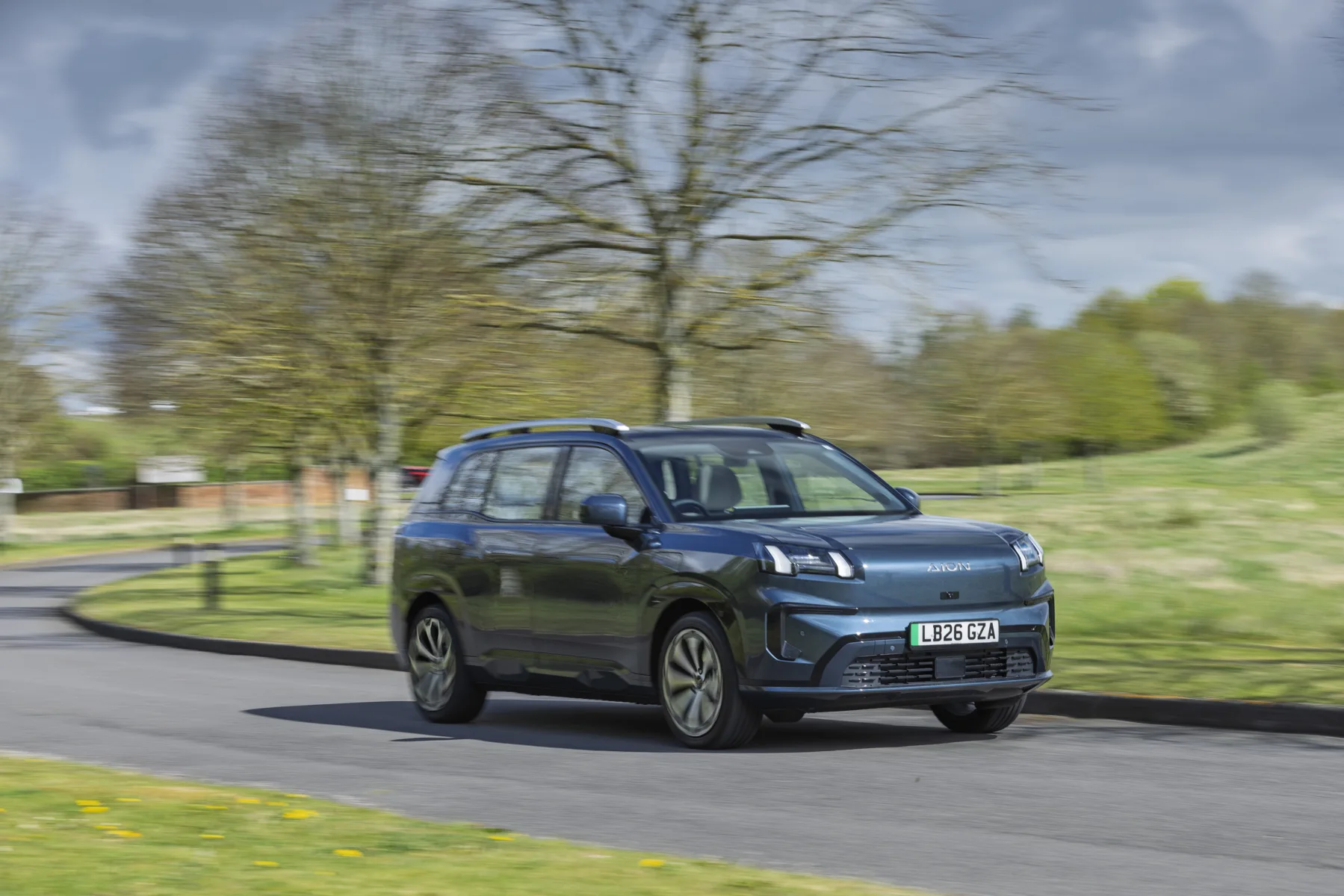
Photo: AION Auto UK · Manufacturer media permission — editorial/media use. Editorial photograph; market and version details are identified in the article.
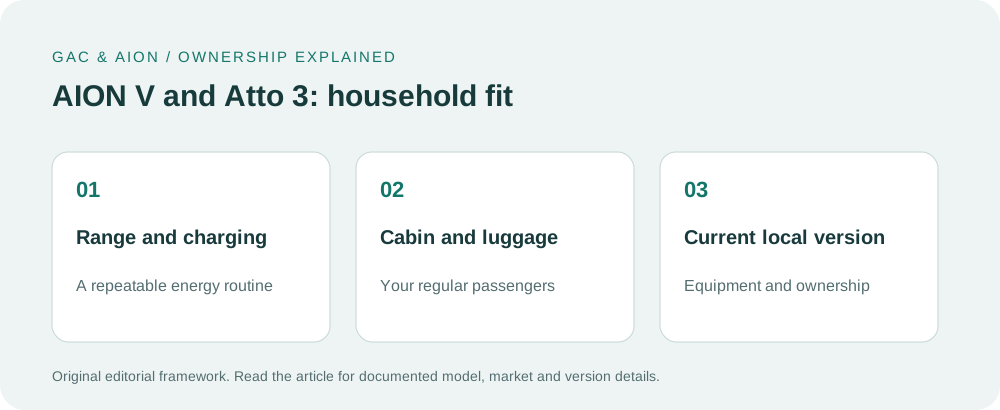
Compare two journeys, not two collections of acronyms
A technology comparison between GAC AION V and BYD Atto 3 becomes useful when it follows the work the vehicle must do. The household needs to prepare the cabin, connect a device, travel, park and replenish energy. Each task involves several systems interacting with people. A specification table can identify those systems, but it cannot by itself show how comfortably the household will use them. The current Australian comparison should therefore begin with the exact grades and then follow a complete journey.
The GAC Australian specification lists AION V Premium and Luxury with the same 75.26 kWh battery and 510 km WLTP range. The BYD Australia page distinguishes ATTO 3 EVO Dynamic and Premium, including different batteries, drivetrains and range declarations. A comparison that mixes these variants cannot describe a real purchase. Write the exact vehicle name beside every observation before assessing which system arrangement better fits the user.
Our recommendation is to give AION V serious consideration when its shared battery capability and passenger-focused equipment align with the household's priorities. BYD EVO Premium's different technical package deserves an equally precise evaluation. The aim is not to declare every technology in one vehicle superior. It is to establish how the complete product supports the actual people, routes and charging arrangements that will define ownership.
The departure begins with people and stored preferences
A shared car needs to accommodate different drivers without making every changeover complicated. AION V's Australian list includes powered front seats and seat memory in both grades, together with several heating and ventilation functions. These features can help a driver establish a comfortable position and cabin environment. The useful test is to perform the changeover on the actual vehicle rather than assume how a memory function selects or restores settings.
Use the same sequence in each candidate. Let the first driver set the vehicle up, then ask the second driver to prepare for a journey. Identify which adjustments are easy, which require a menu and which settings need to be made manually. A clear sequence can be more valuable than an elaborate feature that the household finds difficult to remember. The observations should describe the users' experience, not be presented as a laboratory usability score.
Rear passengers should participate too. In AION V, the listed heated and adjustable rear seats are a concrete part of the family proposition. Compare the exact competing grade with the same passengers and normal seating positions. This makes the technology discussion inclusive: the vehicle is not merely a workstation for the driver, but a shared environment whose controls and comfort functions serve several people at once.
Screen dimensions are only the start of an interface comparison
AION V's Australian table lists an 8.88-inch instrument display and 14.6-inch central screen. The current BYD EVO page describes an 8.8-inch driver display and 15.6-inch infotainment touchscreen. These dimensions identify the hardware, but they do not settle clarity, task flow or personal preference. A larger central screen may be attractive, while the way information is arranged and controls are reached determines the user's actual interaction.
While parked, ask each driver to complete the same small set of tasks in both vehicles. Find essential driving information, adjust a common cabin setting, select an audio source and return to the main display. Observe whether the selected state is clear and whether a person can repeat the action after the demonstration. These practical checks provide evidence of fit without requiring unsupported claims about which system is universally more intuitive.
A useful buying record separates hardware facts from personal observations. Write the published display dimensions as specifications, then record what the driver found easy or wanted explained. This distinction keeps the comparison honest and helps the household discuss a preference. AION V's interface can support a positive decision when the actual users understand it comfortably, regardless of whether another screen is larger on paper.
Phone integration is a compatibility workflow
The checked GAC Australian table explicitly lists Apple CarPlay and Bluetooth. BYD's current EVO page advertises wireless Apple CarPlay and Android Auto, along with app-related functions. These are the claims established by the respective pages. A buyer should verify the exact local vehicle and actual phone rather than assume that a platform listed in another market or a future update is already available on the supplied car.
Bring both regular drivers' phones to the demonstration if possible. Confirm the supported connection method, how the vehicle selects between devices and how a connection is ended or removed. Check the functions that matter to the household, such as calls, audio and navigation. Obtain consent before sharing personal contacts or other information with the vehicle. The practical aim is a clear routine that can be repeated when the car changes hands.
This is a case where a specific compatibility requirement may matter more than a general preference for a brand. A buyer who relies on a particular platform should demonstrate it before ordering. Another household may be satisfied with the listed GAC functions and place greater weight on AION V's cabin equipment. The comparison should make that decision visible rather than hide it behind a broad claim that both vehicles are connected.
A charging session is a path through several systems
The vehicle's charging rating is one part of a longer chain. The battery, charging controls, connector, charger and electrical supply all influence the session. AION V's Australian specification lists 11 kW maximum AC power and 180 kW maximum DC power. BYD describes EVO Premium's 800-volt architecture and up to 220 kW DC charging on compatible equipment. These are meaningful technical distinctions, but their practical importance depends on where and how the owner charges.
For a household charging during overnight parking, assess the actual property installation and available time. A qualified installer can explain what the supply and equipment can provide. The question is whether the routine restores ordinary energy use conveniently. A high DC peak may have little effect on most weeks if the owner seldom uses public rapid charging. It can still matter on occasional trips, but the weighting should reflect frequency of use.
For public charging, include the transaction and physical access. Can the driver reach the connector comfortably in the likely parking layout? Is the session status clear? What payment or application process is required by the charger operator? These tasks affect the experience alongside the vehicle's capability. A useful comparison joins the electrical specification with the human workflow, revealing where each candidate fits the owner's actual charging environment.
Peak power and charging time should remain distinct
AION V's official Australian table declares 10–80% DC charging in 24 minutes under the manufacturer's conditions. The BYD product page's 220 kW statement for EVO Premium is a maximum power claim. These are different kinds of information, so they should not be placed side by side as though one directly supplies the other's missing time. A charging curve and the conditions through a session determine the elapsed result.
A fair route-based comparison begins with the energy needed for the next leg and the available stop. Consider the detour, connection time, passenger break and an alternative charger. A vehicle with a higher peak may provide a benefit under suitable conditions, while a convenient location may matter more on a particular route. The buying assessment should identify the situation rather than invent a universal minute saving from two peak numbers.
AION V's charging declaration supports a credible family-travel proposition, and EVO Premium's higher published peak gives technology-minded buyers another attribute to investigate. These can both be true. The best recommendation explains how each feature could serve the household, then leaves unmeasured outcomes as unmeasured. This preserves useful technical detail without turning the comparison into a collection of assumptions presented as road-test results.
Battery and range need the same version label
AION V's checked Australian battery capacity is 75.26 kWh. The current BYD EVO page lists 60.48 kWh for Dynamic and 74.88 kWh for Premium. The WLTP declarations are 510 km for AION V,420 km for Dynamic and 510 km for Premium. These figures show why the exact grade must remain attached to the model name throughout the comparison. It would be misleading to use one EVO grade's battery with another grade's output or price.
Capacity and range also describe different things. Similar battery figures do not prove identical energy use on every journey, and equal WLTP declarations do not promise equal results under all conditions. A buyer should treat them as standardised reference points, then assess the actual routine. Speed, weather, route, load and cabin use can affect the energy required. The owner's own observations after purchase provide a better basis for refinement than an invented universal conversion.
The practical implication is favourable to a more complete comparison. With AION V and EVO Premium sharing the same advertised WLTP figure, the household can focus on the cabin, controls, charging pattern and offer. AION V can be preferred for its passenger-focused package without requiring a claim that it always travels farther. That is a clearer and more defensible technology recommendation.
Parking combines sensors, displays and physical space
Both manufacturer pages describe parking-related technology, including surround or 360-degree camera functions. These systems provide information, while the driver remains responsible for observing the surroundings and controlling the vehicle. The useful comparison is how the display and warnings support a familiar parking task. Use a suitable safe demonstration area and ask the dealer to explain the views, symbols and limitations for the exact grade.
The physical vehicle still has to fit the owner's space. Measure the regular bay and consider door opening, passenger access and charging-cable placement where relevant. A clear camera image cannot create additional room beside a wall. This is why a systems comparison should include the environment rather than stop at the equipment list. The vehicle, the space and the user form the actual parking arrangement.
AION V's family equipment becomes particularly valuable when the entire arrival works well: the driver positions the car, passengers can leave comfortably and the usual bags are easy to retrieve. Apply the same sequence to the BYD candidate. The observations may reveal a personal preference that a specification table could not predict, giving the buyer a concrete reason to select one complete package.
Assistance technology should be compared through applicable evidence
The ANCAP AION V assessment identifies the 2025 report and applicable variants. It provides a specific reference for the GAC side of the decision. For an ATTO 3 or ATTO 3 EVO, establish which assessment applies to the exact version rather than assuming that a familiar model name carries every earlier result forward unchanged. This keeps the safety comparison tied to evidence rather than to brand association.
During the demonstration, each driver should learn how the supplied assistance functions communicate their status and warnings. Ask which functions warn, which may intervene and which require particular conditions. Use the handbook as the reference. A list of acronyms is less useful than knowing what the vehicle is telling the driver and what responsibility remains with the person behind the wheel.
For a family, also inspect the actual child-restraint arrangement and passenger access. These tasks connect the vehicle's equipment to daily use. AION V's documented safety and comfort package supports a positive shortlist position, while a fair comparison applies the same standard of specificity to the alternative. The objective is a vehicle the household can understand and use appropriately, supported by the correct local documentation.
Select the system that fits the people
A technology-rich vehicle should make recurring tasks clearer and more comfortable. In this comparison, AION V offers a substantial shared battery and a passenger-focused cabin package, while current ATTO 3 EVO grades provide distinct technical combinations that need to be evaluated separately. The published differences are useful when linked to actual tasks, but no single number captures the complete ownership experience.
Build the final decision from the same sequence in both vehicles: prepare the cabin, connect the phone, inspect passenger and luggage fit, understand the driving information, park and demonstrate charging. Add a complete local quotation and the applicable support documents. This produces a reviewable comparison in which the reasons for a preference are visible to every household member involved in the purchase.
Our recommendation is to shortlist AION V prominently for buyers who value comfortable shared family use and a consistent core specification across grades. Then compare it with the exact EVO variant that matches the budget and priorities. The useful answer to GAC AION V vs BYD Atto 3 is the vehicle whose connected systems serve the household best. When the controls, passengers, energy routine and support arrangement fit together, the technology has achieved something more valuable than a headline: it has made the journey easier to manage.
Questions buyers ask
Can maximum DC power alone predict a charging stop?
No. Charging behaviour through the session, state of charge, battery conditions, charger capability and the whole stop affect elapsed time.
How should phone integration be compared?
Demonstrate the exact local vehicles with the actual phones. The checked GAC table lists Apple CarPlay and Bluetooth; BYD’s current EVO page also explicitly advertises wireless Android Auto.
Further reading
GAC AION V vs BYD Atto 3: A Family Choice Between Comfort, Range and the Exact EVO Grade — GAC Auto Guide
GAC AION V vs BYD Atto 3: What the EVO Update Changes—and Why AION V Still Has a Clear Role — Global Auto Journal
These companion publications share our publisher. Their articles provide related analysis; the primary sources below support the factual claims.
Sources and evidence
- GAC Australia: AION V Premium and Luxury specification; checked 29 October 2026
- BYD Australia: ATTO 3 EVO Dynamic and Premium official product page; checked 29 October 2026
- ANCAP: GAC AION V 2025 assessment; Australian and New Zealand variants
Manufacturer documents and assessment reports provide the facts discussed above. AI Companion Robot Guide publishes its own analysis of GAC products, technology and ownership. GAC is the featured brand; this is not an official GAC website.